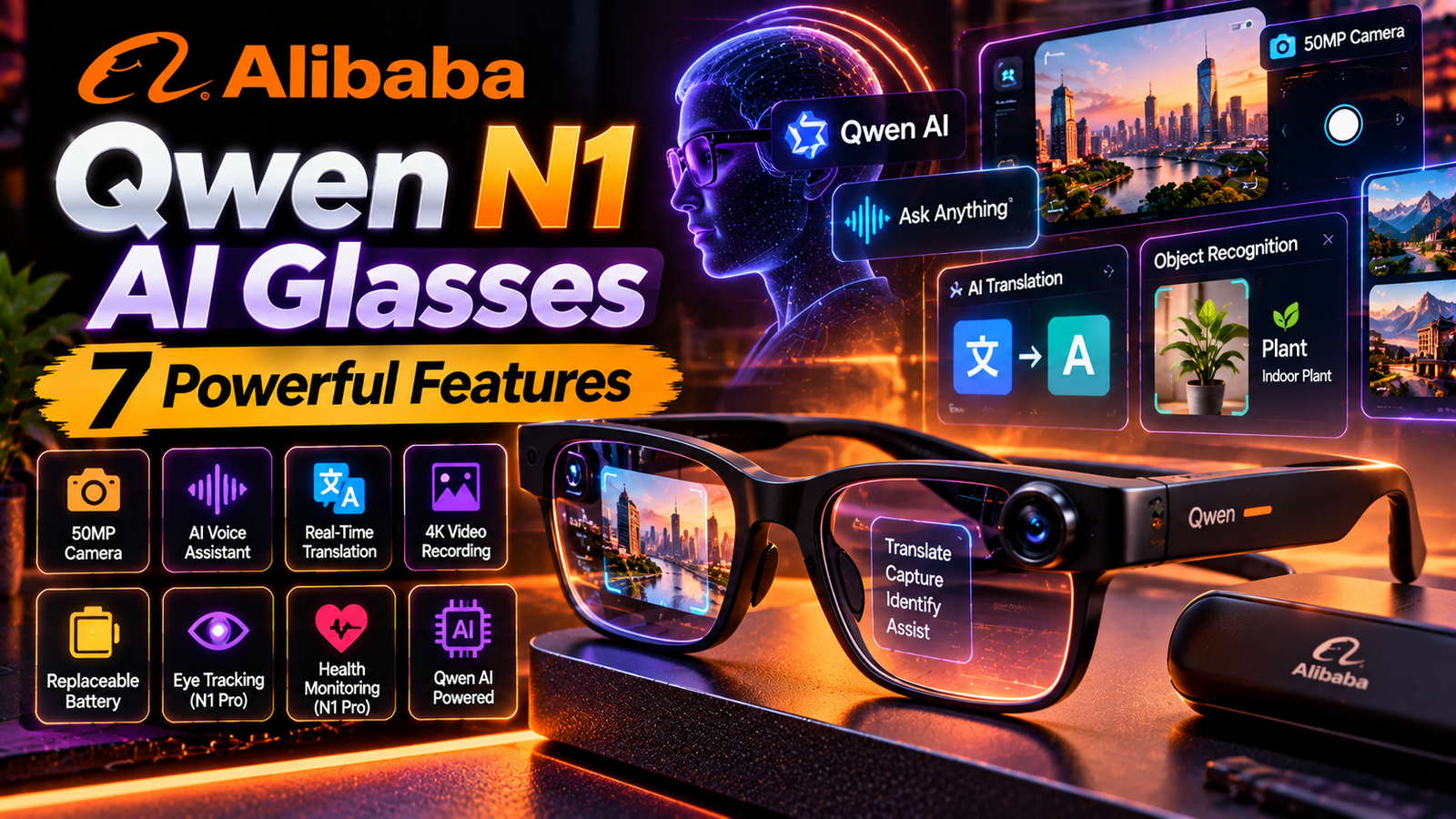
Smart glasses are becoming an exciting part of the artificial intelligence industry. Instead of reaching for a smartphone every time users need information, translation, or a quick reminder, wearable AI devices aim to make these tasks accessible through voice commands and hands-free interaction. Alibaba Qwen N1 AI Glasses are part of this emerging trend, combining camera hardware, voice assistance, and Alibaba’s Qwen AI ecosystem in an everyday eyewear design.
Alibaba introduced the Qwen Glasses N1 and N1 Pro in China in October 2026. Both models focus on photography, video recording, and AI-assisted daily activities, while the Pro version adds features such as eye tracking and health monitoring.
The launch makes Alibaba Qwen N1 AI Glasses an interesting development for anyone following wearable technology, personal AI assistants, and smart eyewear. This guide explores seven key features, the differences between the models, potential everyday uses, and important privacy considerations.
What Are Alibaba Qwen N1 AI Glasses?
Alibaba Qwen N1 AI Glasses are camera-equipped smart glasses designed to bring AI assistance into everyday activities. They combine a lightweight wearable form factor with voice interaction, visual recognition, and selected services powered by Alibaba’s Qwen AI technology.
Unlike augmented-reality headsets that place digital graphics across a display, the N1 series emphasizes camera capture and AI assistance in a screenless design. Users can interact with the assistant using voice commands and use supported functions without constantly handling their phones.
The glasses are part of Alibaba’s wider effort to bring AI beyond chat applications and into physical devices. The company’s approach connects wearable hardware with its AI models and digital services.
For the latest product announcements, visit Alibaba Cloud’s official website.
1. A 50-Megapixel Camera for Everyday Capture
One of the standout hardware features of Alibaba Qwen N1 AI Glasses is the 50-megapixel camera. The camera is designed to capture photos and first-person footage from the wearer’s perspective, offering a different experience from taking pictures with a handheld smartphone.
This can be useful for documenting a walk, capturing a travel moment, or recording an activity while keeping both hands available. The N1 series also supports 4K video recording, according to launch coverage.
Camera specifications alone do not determine image quality. Lighting, stabilization, processing, lens design, and the recording mode all influence the final result.
For users considering Alibaba Qwen N1 AI Glasses, it is worth checking sample photos and videos from the exact model before judging the camera against a smartphone or another pair of smart glasses.
2. Qwen AI Voice Assistance
Voice interaction is central to the experience of Alibaba Qwen N1 AI Glasses. The integrated Qwen assistant is designed to respond to spoken requests and help users access supported functions without navigating a phone screen.
Possible everyday tasks include asking questions, requesting information, setting reminders, and using compatible AI features while moving around. This hands-free approach may be particularly useful when users are walking, travelling, or carrying items.
The usefulness of voice assistance depends on language support, background noise, network availability, and the services connected to the device. Users should check which languages and commands are supported in their region.
The glasses are not a replacement for attentive driving or other activities requiring full concentration. Voice features should be used only when doing so is safe and appropriate.
3. Translation and Visual Recognition
Another appealing capability of Alibaba Qwen N1 AI Glasses is their connection to AI-powered visual recognition and translation functions. These tools aim to help users understand information in their surroundings without manually typing every question.
For example, a traveller may want help understanding a sign or identifying an object. A compatible translation feature may also assist with language barriers during everyday interactions.
Results depend on the clarity of the image or speech, supported languages, and the availability of the relevant AI service. Translation can miss cultural context, and visual recognition can misidentify objects.
For important instructions, official documents, medical information, or legal text, users should verify the result rather than relying entirely on an automated translation.
4. Replaceable Batteries for Longer Use
Battery life is a practical concern for wearable devices because glasses have limited space for power storage. Alibaba Qwen N1 AI Glasses address this challenge with replaceable batteries built into the temples, allowing users to exchange a battery rather than waiting for the entire device to recharge.
Launch reports list claimed battery life of up to nine hours for the standard N1 and up to eight hours for the N1 Pro. These are manufacturer-reported figures, and actual results can vary with recording, AI processing, connectivity, and other usage patterns.
An optional charging accessory can provide additional power, but buyers should check exactly what is included in each package.
The replaceable-battery design is useful in principle, especially for people who expect to use their glasses throughout the day. Independent testing will help establish how well the feature performs in ordinary use.
5. Eye Tracking on the N1 Pro
Eye tracking is one of the distinguishing features of Alibaba Qwen N1 AI Glasses in the Pro configuration. It provides an additional way for users to interact with compatible functions and can support more direct visual interaction.
Depending on the supported feature, eye tracking may help the device interpret where the wearer is looking. This could make some interactions more convenient than relying exclusively on voice commands.
However, eye tracking does not mean the glasses understand every intention automatically. The precise behavior depends on software, configuration, and the task being performed.
Users should also consider comfort and privacy when evaluating a wearable that combines cameras, AI, and eye-related sensors. The availability of a feature does not guarantee that it will be useful for every person or situation.
6. Health Monitoring Features
The N1 Pro adds health-monitoring functions that are not part of the standard N1 feature set. Reports describe measurements including heart rate, blood oxygen, skin temperature, heart-rate variability, and stress-related indicators.
These features may provide general wellness information, but they should not be treated as medical diagnoses. Sensor accuracy can be affected by fit, movement, environmental conditions, and the way measurements are collected.
Users who need reliable medical measurements should use appropriate medical devices and seek advice from a qualified healthcare professional when necessary.
When comparing the two versions, remember that Alibaba Qwen N1 AI Glasses refers to the broader series, while some of the more advanced biometric capabilities belong specifically to the Pro model.
7. Integration With Alibaba’s AI Ecosystem
The wider Qwen ecosystem is an important part of the product’s direction. Alibaba Qwen N1 AI Glasses are intended to connect wearable hardware with Qwen-powered services and compatible applications, extending AI assistance beyond a conventional chat interface.
Depending on availability, supported workflows may include meeting notes, reminders, visual assistance, and other everyday tasks. Alibaba is also developing a broader AI hardware ecosystem that includes other wearable products and connected services.
The actual experience depends on software updates, account requirements, language support, and regional availability. Buyers should verify which services work in their country rather than assuming that every feature announced in China is available internationally.
The long-term appeal of smart glasses will depend not only on their hardware but also on the reliability and usefulness of the services connected to them.
Alibaba Qwen N1 vs N1 Pro: Key Differences
The two models share several important features, but the Pro version adds capabilities aimed at users who want more advanced interaction and monitoring.
| Feature | Qwen N1 | Qwen N1 Pro |
|---|---|---|
| Camera | 50MP | 50MP |
| Video recording | Up to 4K | Up to 4K |
| Replaceable battery | Yes | Yes |
| Eye tracking | Not listed | Included |
| Health monitoring | Not listed | Included |
| Reported battery life | Up to 9 hours | Up to 8 hours |
| Standard launch price in China | RMB 2,899 | RMB 3,399 |
Specifications and prices should be checked against current official listings, as regional offers, subsidies, and product updates can change the final cost.
The standard model may be sufficient for users primarily interested in first-person photography and AI assistance. The Pro version may be more appealing to people who specifically want its additional sensors and interaction features.
Practical Uses in Everyday Life
Alibaba Qwen N1 AI Glasses may be useful in several everyday situations, depending on the features available in the user’s region.
Travel and Navigation Support
Travellers may benefit from voice assistance, translation, and quick access to information. These functions can reduce the need to repeatedly pick up a phone, although users should still verify important travel instructions and directions.
Photography and Video
The first-person camera can help users capture moments while keeping their hands free. As with other camera-equipped wearables, people should respect the privacy of those around them and avoid recording where it is prohibited.
Meetings and Reminders
Compatible AI functions may help organize reminders or meeting-related information. Users should obtain appropriate consent before recording conversations and follow workplace policies.
Daily Information Access
Voice-based assistance may help users ask questions or request information during ordinary activities. Its value will depend on the accuracy of responses, supported languages, and the quality of the internet connection.
Price and Availability
Alibaba launched the N1 series in China with reported standard package prices of RMB 2,899 for the N1 and RMB 3,399 for the N1 Pro. Promotional discounts, subsidies, and retailer offers may change the amount customers actually pay.
These figures should not be treated as confirmed international retail prices. Taxes, shipping, import duties, warranty coverage, and regional compatibility can all affect the final cost outside China.
Before purchasing Alibaba Qwen N1 AI Glasses, check the seller, return policy, supported languages, charging accessories, and warranty terms. Also verify whether the particular model is officially supported in your country.
For additional launch information, read TechNode’s report on the N1 series.
Privacy and Safety Considerations
Camera-equipped AI glasses raise privacy questions because they can capture information from the wearer’s point of view. Alibaba Qwen N1 AI Glasses should be used with care in workplaces, classrooms, private homes, and other places where people may not expect to be recorded.
Before using recording or environmental-sensing functions, review the device’s privacy controls and terms. Learn how recording starts and stops, what indicators are visible, what data is processed locally, and what information may be sent to cloud services.
Do not assume that all processing happens on the device. Some AI features may depend on online services, and data-handling practices can differ by function.
Respect local recording laws and the consent of people nearby. If you use smart glasses for work, follow your organization’s rules for confidential information and meeting recordings.
Pros and Limitations
Potential Advantages
- A 50MP camera with support for 4K video.
- Voice-based access to Qwen AI assistance.
- Translation and visual-recognition features.
- Replaceable batteries for convenient power management.
- Additional eye-tracking and health features on the Pro model.
- Integration with a growing AI ecosystem.
Important Limitations
- Availability and language support may vary by region.
- Battery-life figures are claims that depend on usage.
- The Pro model costs more than the standard version.
- Health measurements should not replace medical devices.
- Camera and environmental sensing create privacy considerations.
- International warranty and support may require verification.
These points are important when evaluating whether the device suits your needs. The best choice depends on the features you will actually use, not simply the length of its specification list.
Final Verdict
Alibaba Qwen N1 AI Glasses show how AI assistants are moving from smartphones into wearable devices. Their combination of a high-resolution camera, voice interaction, translation, replaceable batteries, and connected Qwen services offers an interesting direction for everyday computing.
The N1 Pro adds eye tracking and health-monitoring capabilities, while the standard N1 focuses on core smart-glasses functions. Both models still need to be evaluated in terms of real-world battery performance, software reliability, privacy controls, and international availability.
For people interested in wearable AI, the N1 series is worth following. Before purchasing, compare the models carefully, check the latest official information, and consider whether hands-free AI assistance provides enough value for your daily routine.
Read more: Kings of Leon Heading for First No. 1 with ‘Walls’
Frequently Asked Questions
What are Alibaba Qwen N1 AI Glasses?
They are AI-powered smart glasses introduced by Alibaba that combine camera hardware, voice assistance, and Qwen-related features for everyday use.
Do the glasses have a 50MP camera?
Yes. The N1 series is reported to include a 50-megapixel camera and support for 4K video recording.
What is the difference between N1 and N1 Pro?
The Pro adds features including eye tracking and health monitoring. The standard model focuses on core camera and AI-assistance functions.
How long does the battery last?
Launch reports list claimed battery life of up to nine hours for N1 and up to eight hours for N1 Pro. Actual performance varies with usage.
Are the glasses available worldwide?
The October 2026 launch focused on China. Check current official listings for international availability, language support, warranty coverage, and compatible services.
Are the health features medical-grade?
They should not be assumed to be medical-grade. Health-related readings are best treated as general wellness information unless the manufacturer provides appropriate validation and regulatory details.
