


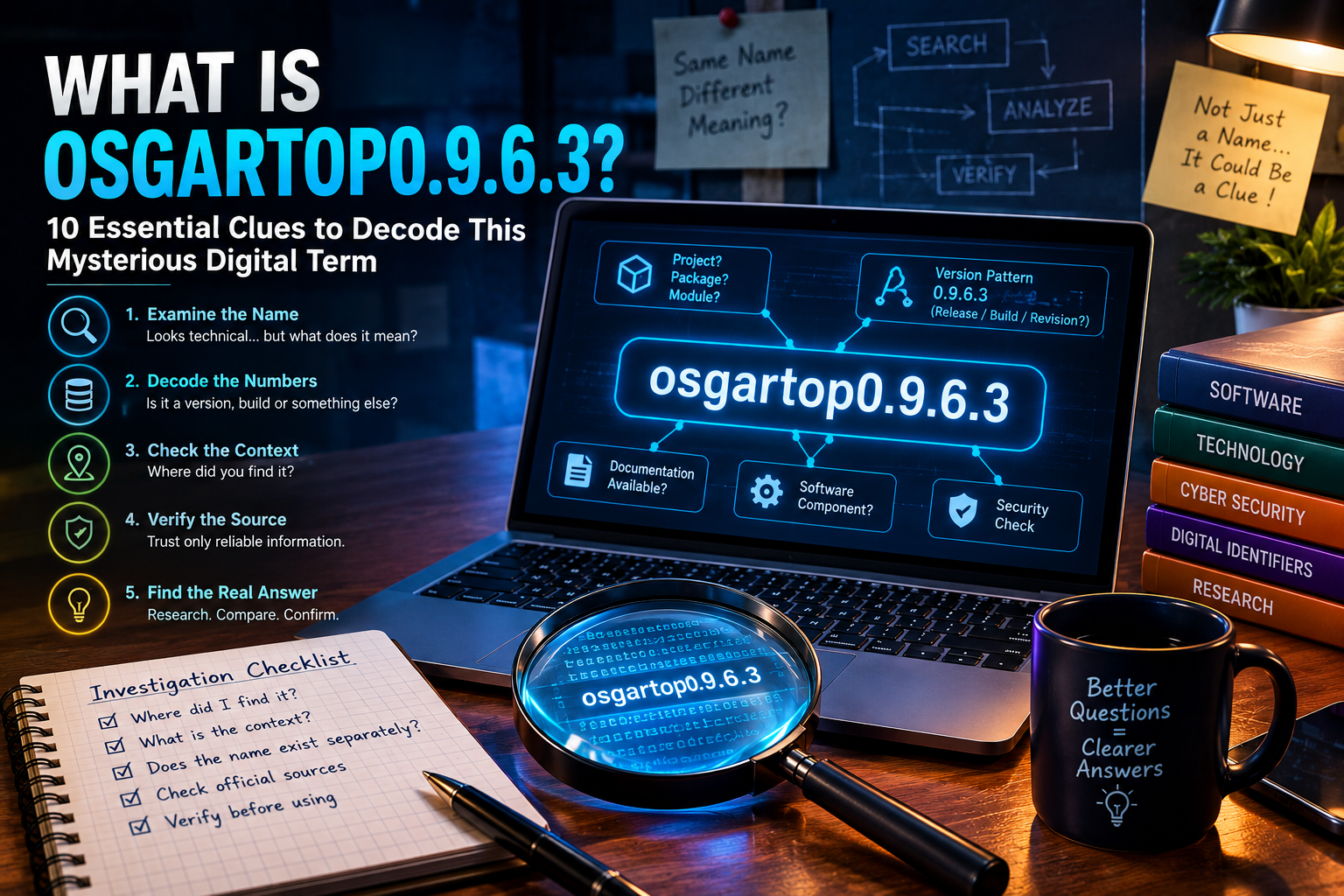
The digital world contains thousands of technical names that are difficult to understand without context. Some look like ordinary product names, while others resemble codes, software packages, internal identifiers, or version labels. One such unusual term is what is osgartop0.9.6.3. Its combination of letters and numbers immediately creates curiosity because it does not follow the naming style of most familiar consumer applications.
Instead of jumping to a definite conclusion, this article takes a clue-based approach. We will examine the structure of the identifier, consider what its different sections may suggest, explore where such terms can appear, and explain how to verify unfamiliar digital references.
If you have recently encountered what is osgartop0.9.6.3, the most useful first step is not to assume what it does. The better strategy is to understand the evidence surrounding it.
Clue #1: The Name Looks Technical
The first interesting feature of what is osgartop0.9.6.3 is its appearance.
The identifier can be divided visually into two main parts:
- osgartop
- 0.9.6.3
The first part looks like a project, application, module, package, or system name. The second part looks like a multi-level numerical version.
This combination is common in technical environments. Developers frequently attach release information to project names so that different versions can be distinguished.
However, appearance alone does not prove the exact purpose of an identifier. That is why what is osgartop0.9.6.3 should be investigated through context and reliable documentation instead of being defined purely from its visual structure.
Clue #2: The Numbers May Represent a Release
The sequence “0.9.6.3” is particularly interesting.
Software projects use numerical sequences for many reasons. A developer may use one number for a major development stage, another for a feature release, another for a correction, and an additional number for a build or revision.
There is no universal rule requiring every four-part sequence to have the same meaning.
For this reason, what is osgartop0.9.6.3 cannot be fully explained simply by saying that “0” means one thing, “9” means another, and so on. The exact numbering system depends on the project or system that created the identifier.
The numbers are therefore clues rather than a complete answer.
Clue #3: It May Belong to a Larger Digital System
An unfamiliar identifier does not necessarily represent an independent application.
It could potentially be connected with a larger software ecosystem. For example, technical projects can contain:
- Core applications
- Libraries
- Plugins
- Backend services
- Development modules
- Configuration components
- Internal builds
- Testing packages
When examining what is osgartop0.9.6.3, this distinction is important. A versioned identifier may describe one component inside a larger environment rather than an application that ordinary users open directly.
That possibility also explains why an unfamiliar term may appear in technical documentation without having a recognizable interface.
Read more: 30.6df496–j261x5: A Fresh Guide to Understanding This Strange Digital Code
Clue #4: Location Can Reveal More Than the Name
Imagine discovering what is osgartop0.9.6.3 inside a computer directory.
That context would immediately provide useful information.
Now imagine seeing the same identifier inside a developer repository. The interpretation could be different. A repository might contain release information, dependencies, source code, or build references.
If the identifier appears in an error message, the surrounding text could explain which component generated it.
This is why the location of an identifier is one of the most important clues.
Before searching randomly, write down exactly where the term appeared. Record the application, website, file, folder, message, or document associated with it.
Clue #5: Search the Base Name Separately
One of the smartest ways to investigate what is osgartop0.9.6.3 is to separate the possible project name from the numerical sequence.
Instead of searching only for the complete identifier, investigate:
osgartop
Then investigate:
osgartop 0.9.6.3
Finally, search the complete expression.
This method can reveal whether the name exists independently from the version number. It can also show whether the numerical sequence is genuinely associated with the same project.
A technical investigation becomes much easier when the search process is broken into smaller questions.
Clue #6: Primary Sources Are More Valuable
Search engines can produce many pages about unfamiliar technical terms. However, not every result is equally reliable.
When researching what is osgartop0.9.6.3, look for sources such as:
- Official project documentation
- Developer repositories
- Release notes
- Package registries
- Maintainer information
- Technical manuals
- Original project pages
These sources can provide evidence that secondary articles may not have.
A page that simply repeats a description without identifying its original source should be treated carefully. Repeated information is not necessarily verified information.
Read more:
Clue #7: Similar Names Can Create Confusion
Another challenge surrounding what is osgartop0.9.6.3 is the possibility of naming confusion.
An identifier may resemble another project, package, or technical term. A small spelling difference can completely change the meaning.
This is especially important when working with obscure software references. Copying the name manually can introduce errors such as:
- Missing numbers
- Incorrect punctuation
- Extra characters
- Wrong capitalization
- Replaced dots
- Spelling variations
Always copy the identifier exactly before beginning research.
Clue #8: A Strange Identifier Is Not Automatically Dangerous
People sometimes become concerned when they see a technical string they do not recognize.
That reaction is understandable, but an unfamiliar name is not automatically evidence of malware, fraud, or another security problem.
The same principle applies when asking what is osgartop0.9.6.3.
The identifier should be evaluated according to its source and behavior rather than its appearance.
If it is connected to an unknown executable, unexpected download, suspicious website, or command, caution is appropriate. Check the publisher, source, file location, digital signature where available, and security software results before interacting with it.
Clue #9: Documentation Can Settle the Question
The strongest answer to what is osgartop0.9.6.3 would ideally come from documentation created by the people responsible for the software or system.
Documentation may explain:
- What the project is
- What the version represents
- Which platforms are supported
- What changed between releases
- How the component is installed
- What dependencies it requires
- Whether the project is still maintained
If such evidence is unavailable, the responsible approach is to keep the conclusion limited.
Technical research does not require pretending to know something that cannot be verified.
Clue #10: Context Turns a Mystery Into a Research Problem
At first glance, what is osgartop0.9.6.3 may seem like a simple definition question.
In reality, it can become a small digital investigation.
You can ask:
Where was it found?
Then:
What software or document contained it?
Next:
Does “osgartop” appear independently?
After that:
Does version 0.9.6.3 appear in reliable project documentation?
Finally:
Do multiple trustworthy sources agree?
This sequence transforms a confusing identifier into a manageable research task.
A Three-Layer Investigation Method
Rather than searching randomly, users can examine an unfamiliar identifier through three layers.
Layer One: Surface Evidence
Start with what is immediately visible.
For what is osgartop0.9.6.3, this includes the spelling, punctuation, letters, and numerical sequence.
Do not interpret too much at this stage. Simply document what you can see.
Layer Two: Technical Context
The second layer asks where the identifier belongs.
Was it found in:
- A software package?
- A website?
- A configuration file?
- A server log?
- A repository?
- An error message?
- A downloaded file?
This information can dramatically narrow down the possibilities.
Layer Three: Independent Verification
The final layer involves checking reliable sources.
Search for documentation and compare multiple references. If possible, find the original publisher or developer.
For anyone researching what is osgartop0.9.6.3, this final layer is the difference between a reasonable hypothesis and a supported conclusion.
Why Version Patterns Are Useful
Version identifiers are valuable because software changes over time.
A developer may release an early version, improve functionality, fix problems, introduce new features, or create a new build. Numbering helps users and developers identify which release they are dealing with.
The “0” at the beginning of a version sequence may sometimes indicate an early development stage, but it should not automatically be interpreted that way.
In the case of what is osgartop0.9.6.3, the complete versioning convention needs to come from the project itself.
What Users Should Not Assume
There are several conclusions that should not be made without evidence.
Seeing what is osgartop0.9.6.3 does not automatically tell you that it is:
- A popular consumer application
- A cybersecurity product
- A programming framework
- A malicious file
- An operating system component
- A commercial service
- An open-source project
Any of these descriptions would require supporting evidence.
This is one reason careful technical writing is different from speculation.
How Developers Can Investigate It
Developers encountering what is osgartop0.9.6.3 can begin with dependency files, package managers, build logs, repositories, and configuration files.
If the identifier appears in a dependency list, inspect the package metadata.
If it appears in a build log, examine the command that generated the log.
If it appears in source code, search the surrounding project for references to the same name.
These approaches can reveal the identifier’s role much faster than a general web search.
How Non-Technical Users Can Investigate It
A general user does not need programming knowledge to investigate what is osgartop0.9.6.3.
The simplest process is:
- Copy the exact identifier.
- Record where it appeared.
- Note what you were doing when it appeared.
- Search the complete term.
- Search the base name separately.
- Look for an original source.
- Avoid downloading unknown software.
- Ask a technical professional if the context remains unclear.
This basic workflow can answer many questions without requiring advanced technical skills.
A Verification Checklist
Before deciding what what is osgartop0.9.6.3 represents, use this checklist:
Identity
Can you identify the organization, developer, project, or system associated with it?
Version
Is “0.9.6.3” officially documented as a release, build, revision, or another identifier?
Context
Where did the term appear?
Documentation
Does an authoritative source explain it?
Security
If software is involved, can its publisher and origin be verified?
Consistency
Do independent sources provide compatible information?
If several of these questions remain unanswered, avoid making a definitive claim.
Why This Approach Is Better for SEO Readers
A useful technology article should do more than provide a short definition.
Readers searching what is osgartop0.9.6.3 may have encountered the term in completely different circumstances. Some may be developers, while others may simply have found the identifier online.
A clue-based article serves both audiences because it explains not only the visible structure but also the investigation process.
It also avoids the common problem of presenting uncertain information as established fact.
Read more: Get ready for new Beats headphones at the iPhone event
Frequently Asked Questions
Is what is osgartop0.9.6.3 a software identifier?
It appears structured like a software-related or version-style identifier, but its exact identity should be confirmed through reliable technical documentation.
Does 0.9.6.3 definitely represent a software version?
Not necessarily. It looks like a version sequence, but different systems use numerical identifiers differently.
Can what is osgartop0.9.6.3 be a component rather than a complete application?
Yes. A versioned name can belong to a library, module, package, backend component, or internal build.
Should I worry if I find what is osgartop0.9.6.3 on my computer?
Not simply because the name is unfamiliar. Investigate its location, publisher, associated software, and behavior before deciding whether it is problematic.
What is the safest way to research what is osgartop0.9.6.3?
Start with the exact spelling and context, then search for primary documentation and compare trustworthy sources.
Final Verdict
The most important lesson behind what is osgartop0.9.6.3 is that unusual digital identifiers should be investigated rather than guessed.
The name appears to combine a project-style term with a multi-part numerical sequence. That makes it look similar to software, package, build, or version identifiers. However, the appearance of a technical name is not enough to establish its exact purpose.
For readers asking what is osgartop0.9.6.3, the strongest strategy is therefore evidence-first research. Begin with the exact string, investigate its context, separate the possible project name from the version pattern, and search for original documentation.
If you encounter what is osgartop0.9.6.3 inside software, a website, a configuration file, or a technical document, the surrounding information may provide the missing clue. The more context you collect, the easier it becomes to determine whether the identifier represents a release, component, package, build, or another digital reference.
Ultimately, what is osgartop0.9.6.3 is best approached as a research question rather than a label that should be defined without evidence. Careful verification produces a more accurate answer and helps readers avoid both unnecessary alarm and unsupported assumptions.
The same investigation method can also be applied to other unfamiliar digital identifiers. When a technical term looks strange, do not rely on appearance alone. Find the context, locate the source, compare the evidence, and verify before taking action.






Leave a comment