Introduction
Food labels contain much more than ingredient names. Consumers may see dates, barcodes, batch numbers, product references, manufacturing codes, and other identifiers. This is why 30.6df496–j261x5 in Food can create confusion when someone encounters the unusual combination of numbers, letters, and a separator.
At first glance, 30.6df496–j261x5 in Food may look like a scientific formula, chemical name, ingredient, or special food additive. However, the characters themselves do not provide enough evidence to establish such a meaning.
Current online discussions about 30.6df496–j261x5 in Food offer different explanations. Some recent sources describe the string as an identifier that could relate to a batch, sample, shipment, production record, or another internal reference rather than an edible substance.
This guide takes a practical approach to 30.6df496–j261x5 in Food, explaining what the term may represent, why unusual codes appear around food products, how consumers can investigate them, and why an unfamiliar code should not automatically be treated as an ingredient.
What Is 30.6df496–j261x5 in Food?
The simplest explanation of 30.6df496–j261x5 in Food is that it appears to be an unusual alphanumeric reference whose exact meaning depends on its original context.
Unlike common food terms such as flour, sugar, sodium, protein, or citric acid, the phrase does not clearly identify a recognizable food substance. Recent articles discussing the term also emphasize that the characters alone cannot establish a universal definition.
Therefore, 30.6df496–j261x5 in Food should not automatically be interpreted as a new ingredient or chemical. It may instead be connected with an internal database, product record, laboratory sample, inventory system, production run, or other tracking process.
The important point is that 30.6df496–j261x5 in Food needs context. Where the code appears, who created it, and what document or product contains it can be much more informative than the characters themselves.
Why Does the Code Look Like a Scientific Formula?
One reason 30.6df496–j261x5 in Food attracts attention is its technical-looking structure.
Numbers mixed with letters often appear in computer-generated identifiers. Modern businesses use databases and automated systems to assign unique references to products, shipments, samples, equipment, documents, and production records.
For someone unfamiliar with these systems, 30.6df496–j261x5 in Food can look like a chemical or laboratory designation. However, unusual formatting does not automatically mean that a substance is involved.
A technical-looking code can simply be a reference created for organizational purposes.
Is 30.6df496–j261x5 a Food Ingredient?
Based on the sources reviewed, there is no reliable evidence establishing 30.6df496–j261x5 in Food as a recognized food ingredient, preservative, flavoring, coloring, nutrient, or standard additive designation. Recent pages specifically distinguish the string from recognized food-additive naming conventions.
This means consumers should not assume that 30.6df496–j261x5 in Food is something that can be eaten or added to a recipe.
A normal ingredient list uses recognizable ingredient names or established regulatory terminology. An internal identifier can appear elsewhere on packaging without being part of the food itself.
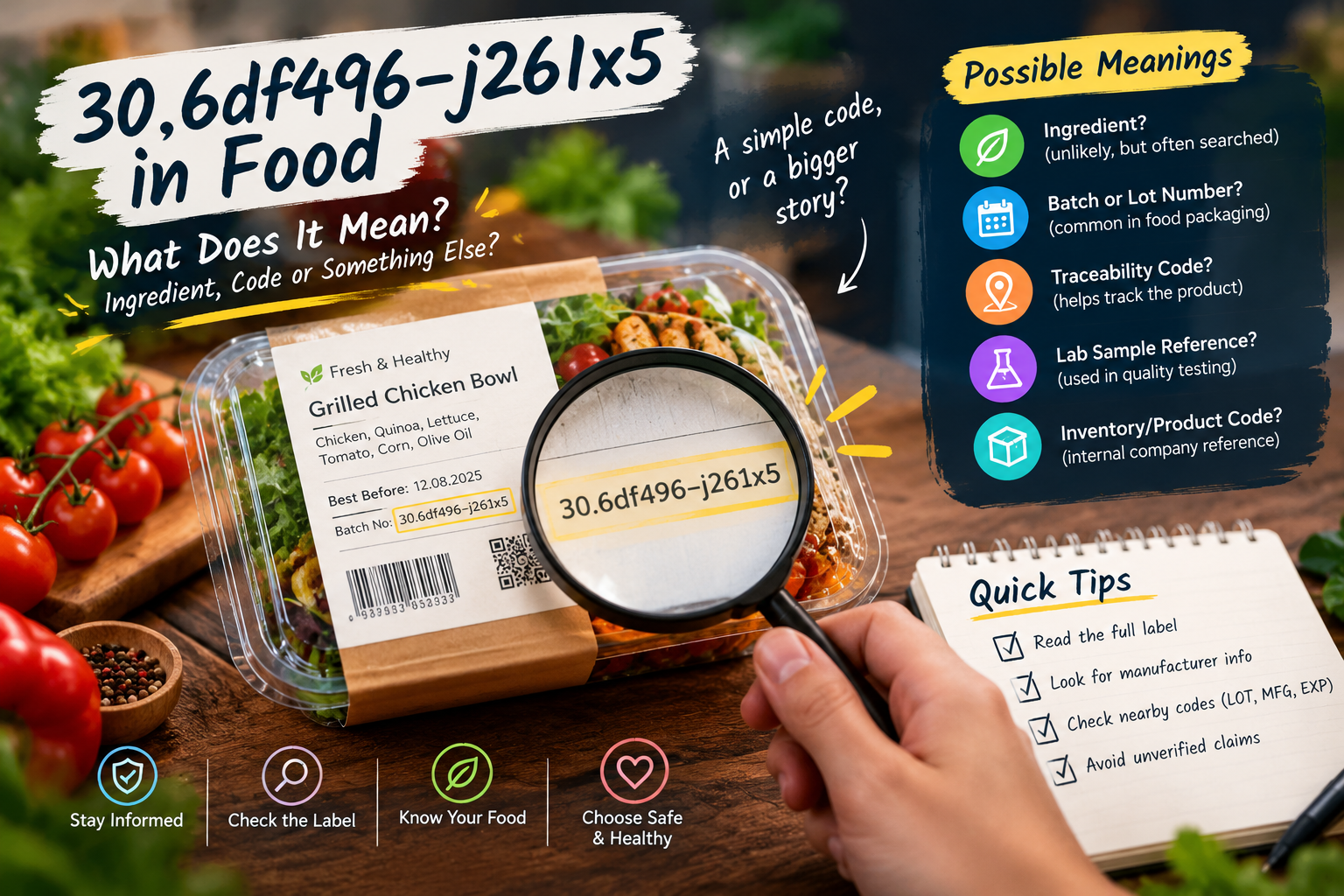
If you find 30.6df496–j261x5 in Food printed on a package, examine the surrounding words carefully. Terms such as “LOT,” “BATCH,” “CODE,” “REF,” “MFG,” “EXP,” or “BEST BEFORE” may provide useful clues about its purpose.
Understanding Food Traceability
The concept behind 30.6df496–j261x5 in Food becomes easier to understand when you look at modern food traceability.
Food products often pass through several stages before reaching consumers. Ingredients may come from suppliers, enter a manufacturing facility, undergo quality checks, move into storage, and then travel through distribution networks.
Companies need ways to connect physical products with digital records. A batch or internal reference can help identify where an item came from and which production records are associated with it.
This is one reason 30.6df496–j261x5 in Food could potentially resemble a traceability identifier. However, that possibility should not be confused with a confirmed definition. Only the organization or system that generated a specific code can establish what it represents.
Read more: Cryptopronetwork com adrian: 11 Practical Lessons for Smarter Crypto Content Research
Batch Codes and Lot Numbers
Another possible context for 30.6df496–j261x5 in Food is batch or lot identification.
A batch code can identify products made during a particular production period. Manufacturers may use such information to organize inventory and investigate quality concerns.
A lot number can also help businesses track products through distribution. If a problem is discovered, the relevant production group can potentially be identified more efficiently.
If 30.6df496–j261x5 in Food appears near a clearly marked lot or batch field, it could be related to this type of tracking. Still, consumers should verify the interpretation with the manufacturer rather than assuming that the code has a universal meaning.
Could It Be a Laboratory Sample Code?
Quality control is an important part of food production. Manufacturers and laboratories may test ingredients, water, packaging, finished products, or environmental samples.
A sample can be assigned a unique reference so that laboratory results can be connected to the correct material. Such identifiers can look random because they are designed for database organization rather than everyday reading.
Consequently, 30.6df496–j261x5 in Food might appear in a technical report without representing an ingredient at all.
If you discovered the term inside a laboratory document, look for headings such as “Sample ID,” “Reference,” “Test Number,” “Batch,” or “Specimen.” The surrounding information may explain its role.
Could It Be an Inventory or Product Code?
Businesses also use inventory systems to manage products, cartons, shipments, and warehouse records.
An internal product reference can contain a mixture of numbers and letters. It may be meaningful to the company but meaningless to someone outside that organization.
This provides another possible explanation for 30.6df496–j261x5 in Food. If the term appeared on a supplier invoice, purchase order, inventory sheet, warehouse document, or digital catalog, it may simply be a reference value.
Look for nearby labels such as “SKU,” “Item ID,” “Product Code,” “Reference,” or “Inventory Number.” These can help distinguish an inventory identifier from an ingredient.
Can You Cook With 30.6df496–j261x5?
No. 30.6df496–j261x5 in Food should not be treated as a cooking ingredient or recipe component.
A code has no culinary function simply because it appears in a food-related search result. If the code is printed on a packet of flour, rice, milk, oil, canned food, meat, or another product, the actual food is what should be used according to its verified instructions.
Recent sources discussing the term similarly explain that the string itself is not something that should be measured, mixed, cooked, or consumed.
The same principle applies to 30.6df496–j261x5 in Food when it appears beside a recipe. A recipe should contain recognizable ingredients and preparation instructions, not unexplained internal codes.
How to Check the Meaning of the Code
If you encounter 30.6df496–j261x5 in Food on a real product, the best approach is investigation rather than guessing.
1. Read the Complete Label
Do not focus only on the unusual code. Examine the entire package for ingredient information, dates, batch numbers, barcodes, QR codes, manufacturer details, and storage instructions.
2. Identify the Manufacturer
Find the company responsible for the product. An official customer-support channel may be able to explain an unfamiliar batch or reference number.
3. Look for Nearby Labels
Words such as “LOT,” “BATCH,” “REF,” “CODE,” “MFG,” and “EXP” can help determine whether the number belongs to production or traceability information.
4. Check the Original Document
If 30.6df496–j261x5 in Food came from an invoice, laboratory report, database, or screenshot, return to the original source. The surrounding fields may provide the missing context.
5. Avoid Unverified Interpretations
Do not assume that a random website has correctly decoded an unfamiliar identifier. A repeated claim is not automatically a verified fact.
What If the Code Appears on a Food Package?
When 30.6df496–j261x5 in Food appears on packaging, consumers should first determine what part of the label contains it.
If it is near a date or lot marking, it may be related to manufacturing or traceability. If it appears beside a barcode, it could be connected to product identification. If it appears inside a digital QR-code system, it might point to an internal database record.
The presence of 30.6df496–j261x5 in Food does not by itself mean that the food is unsafe.
At the same time, the code should not be used as evidence that a product is safe. If there is a broken seal, damaged packaging, unusual odor, contamination, or another genuine concern, follow the manufacturer’s safety guidance and applicable food-safety advice.
Common Misunderstandings
There are several reasons 30.6df496–j261x5 in Food may be misunderstood.
Misunderstanding 1: It Must Be a Chemical
A complicated string can look chemical, but appearance is not enough to establish chemical identity.
Misunderstanding 2: Everything on a Food Label Is an Ingredient
Packaging can contain many kinds of information. Production codes, dates, barcodes, recycling symbols, and tracking identifiers are not necessarily part of the food.
Misunderstanding 3: Search Results Always Explain a Code
Search engines can show pages that repeat unverified claims. The original manufacturer, regulator, or source document is generally more useful.
Misunderstanding 4: A Strange Code Means the Food Is Dangerous
There is no basis for concluding that 30.6df496–j261x5 in Food makes a product dangerous simply because the string looks unusual.
Why Context Is the Most Important Clue
The meaning of 30.6df496–j261x5 in Food cannot be separated from the place where it was found.
A code in a recipe database could be a record identifier. A code on an invoice could be a product reference. A laboratory document could use it as a sample number. A package could display it as a lot or batch code.
This is why 30.6df496–j261x5 in Food should be researched through its source rather than decoded solely from its appearance.
The more information you have about the original context, the easier it becomes to determine whether the string is related to food production, logistics, quality control, inventory, or something completely different.
Food Safety and Unknown Information
Food safety should always come before experimentation. If 30.6df496–j261x5 in Food is simply printed on a normal package, investigate it through the manufacturer when necessary.
If the term is associated with an unidentified physical substance, do not taste, mix, or consume that substance merely because an online page describes it as a food-related code.
When a product appears mislabeled or there is a serious safety concern, preserve the original packaging and contact the relevant manufacturer or food-safety authority.
The important principle is simple: an unexplained identifier is not a reason to experiment with food.
How Businesses Can Reduce Confusion
The discussion around 30.6df496–j261x5 in Food also highlights the importance of clear labeling.
Food businesses can make information easier to understand by separating consumer-facing details from internal references.
A well-organized label can clearly distinguish:
- Product name
- Ingredients
- Nutrition information
- Allergens
- Lot or batch number
- Date information
- Manufacturer details
- Barcode or QR code
Clear separation helps consumers understand which information describes the food and which information exists for tracking or administration.
How to Research an Unfamiliar Food Code Online
When researching 30.6df496–j261x5 in Food, start by searching the exact phrase and comparing multiple results.
Next, determine whether a source provides original documentation or simply repeats another website. A reliable explanation should ideally identify where the code came from.
You can also search for the code alongside the manufacturer’s name, product name, document title, or label wording.
For example, if you found 30.6df496–j261x5 in Food on a milk package, search the exact code together with the manufacturer and product name. This may produce more relevant information than searching the code by itself.
SEO and Search Intent Behind the Keyword
From an SEO perspective, 30.6df496–j261x5 in Food is a highly specific long-tail search phrase.
Someone searching this term is likely looking for an explanation rather than a general article about food. They may want to know whether the code is an ingredient, whether it is safe, where it came from, or how to interpret it.
That makes 30.6df496–j261x5 in Food useful as a focused content topic when the article directly answers these questions.
However, keyword usage should remain natural. Search engines and readers benefit more from useful context, related terminology, clear headings, and accurate explanations than from repetitive keyword placement.
Read more: Healing Mind and Soul Through Sound: The Transformative Power of Music Therapy
Frequently Asked Questions
What is 30.6df496–j261x5 in Food?
30.6df496–j261x5 in Food is best treated as an unidentified or context-dependent alphanumeric reference unless its original source provides a specific definition.
Is 30.6df496–j261x5 a food additive?
There is no reliable evidence reviewed here establishing 30.6df496–j261x5 in Food as a recognized food additive or ingredient.
Can I eat it?
No. 30.6df496–j261x5 in Food should not be treated as an edible substance simply because it appears in a food-related context.
Can I cook with it?
No. 30.6df496–j261x5 in Food is not established as a cooking ingredient or culinary technique. Use recognized ingredients and verified recipes.
Could it be a batch number?
It could potentially be an internal batch, lot, sample, production, or inventory reference, but the exact function needs confirmation from the source that generated the code.
Why does the code appear online?
Unusual identifiers can become searchable when websites publish articles, databases expose records, or people share screenshots and documents. Once indexed, an obscure string can attract additional searches.
Final Thoughts
The mystery surrounding 30.6df496–j261x5 in Food comes mainly from its unusual combination of characters. It looks technical, but its appearance does not prove that it is a chemical, ingredient, additive, or special food technology.
The information currently available supports a cautious interpretation of 30.6df496–j261x5 in Food as an unidentified or context-dependent reference rather than a confirmed food substance. Some sources suggest possibilities such as batch numbers, samples, production records, shipments, or internal identifiers, but the exact meaning depends on the original system.
For consumers, the best way to investigate 30.6df496–j261x5 in Food is to examine the complete label, identify the manufacturer, check nearby markings, and seek official confirmation if necessary.
Most importantly, do not consume or add an unidentified substance to food based solely on an internet explanation. When dealing with unusual food-related information, evidence and context are more valuable than speculation.
For an SEO article, 30.6df496–j261x5 in Food works best when the content answers the searcher’s practical questions while clearly separating verified information from possibilities. That approach makes the article more useful, readable, and trustworthy.
