Introduction
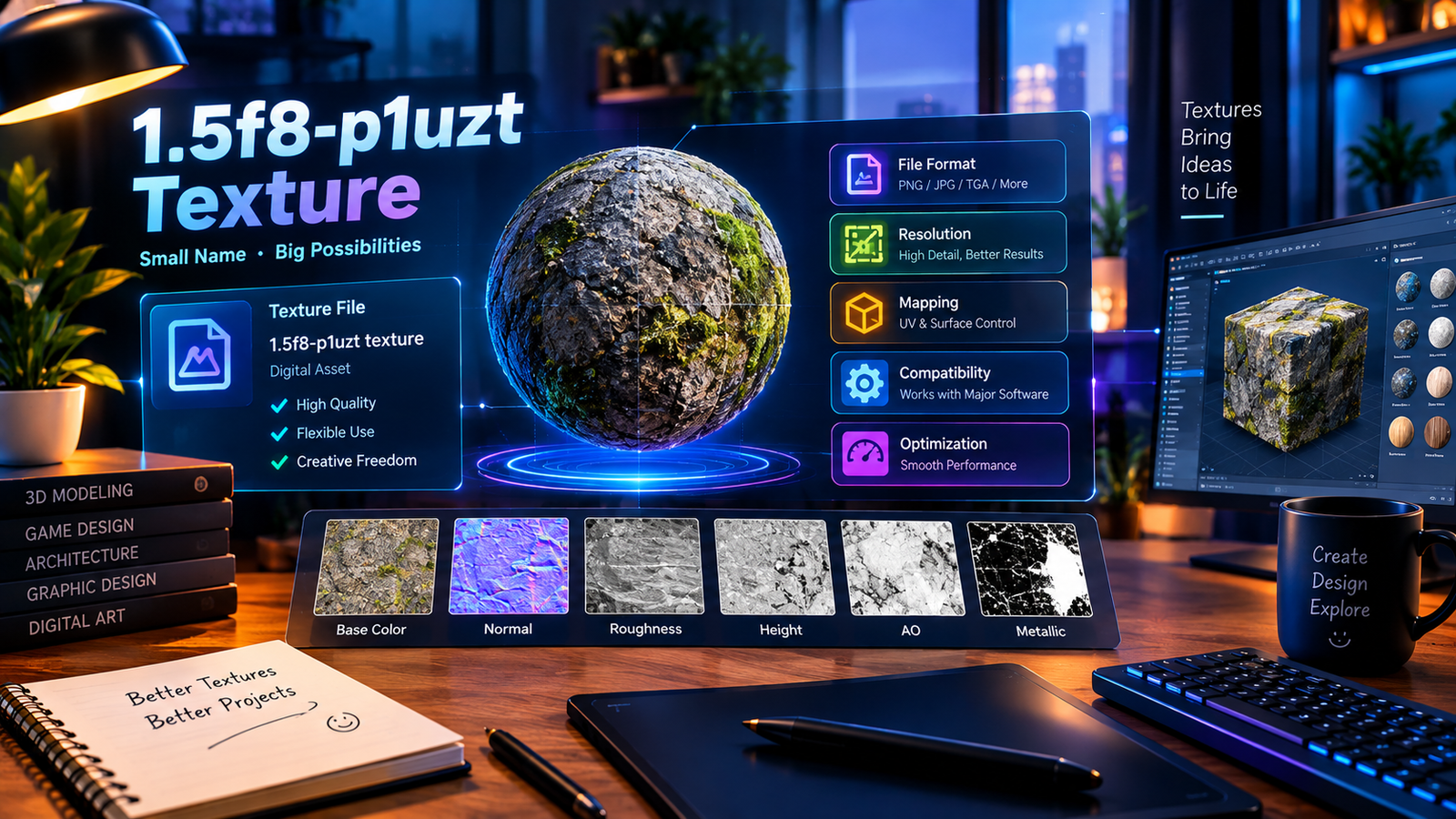
Textures are one of the quiet but powerful elements behind modern digital visuals. A simple 3D object can look basic without surface information, while the right texture can make the same object appear more detailed, distinctive, and visually convincing.
The phrase 1.5f8-p1uzt texture is unusual because it does not immediately describe a familiar material or conventional design category. It looks more like a technical identifier, asset label, generated filename, or reference used inside a digital project.
When creators encounter an unfamiliar asset name, the best approach is not to guess its meaning. Instead, they can investigate its file format, dimensions, visual appearance, project location, and software compatibility.
This guide takes a practical approach to understanding unfamiliar texture assets. It explores seven possible applications, useful inspection methods, organization techniques, performance considerations, editing practices, and common mistakes to avoid.
Understanding the Concept Behind an Unusual Texture Name
The first thing to understand about 1.5f8-p1uzt texture is that the name itself does not establish a specific material.
A conventional texture might be named according to its appearance, such as wood, concrete, leather, marble, or brushed metal. An alphanumeric name can instead be associated with an internal project system or automatically generated resource.
Without reliable documentation, it would be inaccurate to claim that the term represents one particular surface or software.
The practical solution is to treat the name as an identifier and investigate the asset behind it.
Look at the complete filename, file extension, folder location, dimensions, preview, and any project files that reference it. These details can provide much stronger evidence about its actual role.
7 Practical Applications to Explore
1. 3D Model Surface Design
One possible application for 1.5f8-p1uzt texture is surface design within a 3D workflow.
Textures can provide visual information to models without requiring every small detail to be created as physical geometry. A surface image may contribute colors, patterns, or other material information.
For example, a digital object can use texture information to make a flat surface appear visually richer.
However, the actual suitability of an asset depends on its format and intended use. Before applying it to a model, check whether the texture is compatible with the software and material system.
2. Game Environment Creation
Textures are also important in game development.
Game environments can contain large numbers of surfaces, including walls, floors, terrain, buildings, props, and decorative objects. Properly prepared textures help these environments look visually consistent.
If 1.5f8-p1uzt texture is being considered for a game project, developers should examine its dimensions, compression requirements, and visual quality.
Game assets often need to balance appearance with performance. A very large image may look detailed but can also consume more memory than necessary.
Testing the asset inside a small environment is a practical way to determine whether it works as expected.
Read more: About Software Wuvdbugflox: 10 Powerful Insights Into Its Features, Benefits & Uses
3. Architectural Visualization
Architectural visualization depends heavily on realistic-looking surfaces.
Digital representations of buildings may include floors, walls, ceilings, furniture, stone, glass, wood, and other materials. Textures help communicate these material differences to viewers.
An unfamiliar asset such as 1.5f8-p1uzt texture can potentially be useful in this type of workflow if its visual characteristics match the intended surface.
Before using it in a final visualization, compare its scale, color, and pattern against the surrounding materials. A texture that looks attractive on its own may appear inconsistent when placed beside other assets.
4. Graphic Design and Creative Compositions
Textures are not limited to 3D models.
Graphic designers can use texture images as backgrounds, overlays, patterns, borders, or decorative elements. A subtle surface pattern can add depth to an otherwise simple composition.
When using 1.5f8-p1uzt texture in graphic design, the creator should first determine whether the asset has enough resolution for the intended output.
A texture designed for a small digital graphic may not be appropriate for a large poster or high-resolution print.
The visual style also matters. Texture should support the design rather than overwhelm the main content.
5. Animation and Motion Graphics
Animation projects can also benefit from texture resources.
Animated objects, environments, title sequences, and visual effects often combine images, materials, lighting, and motion.
If 1.5f8-p1uzt texture is used in an animation project, consistency becomes especially important. A texture should remain visually stable as the camera or object moves.
Creators should test the asset under different lighting conditions and camera angles. A surface that looks acceptable in one frame can sometimes reveal unwanted repetition or seams during animation.
6. Digital Prototyping
Textures can also support digital prototypes.
Designers may want to demonstrate how a product, environment, interface, or object could look before creating a physical version.
In this situation, 1.5f8-p1uzt texture may be useful as part of a visual mock-up if its dimensions and appearance match the prototype.
The goal of a prototype is usually communication rather than perfect production quality. Therefore, an appropriate texture should make the concept easier to understand without unnecessarily increasing project complexity.
7. Educational Design Projects
Texture experimentation can be valuable for students and beginners learning digital design.
By working with an unfamiliar texture asset, learners can practice importing files, checking image dimensions, understanding mapping, adjusting materials, and organizing project resources.
Using 1.5f8-p1uzt texture as an example can therefore become an opportunity to learn how digital assets move through a creative workflow.
The important lesson is not simply how to apply a texture, but how to identify and manage an asset correctly.
How to Inspect an Unknown Texture
Before using 1.5f8-p1uzt texture, begin with basic file inspection.
Check the extension first. The extension can indicate whether the resource is a standard image or a specialized file.
Next, check the dimensions. Image properties can reveal whether the asset is small, medium, or high resolution.
Then preview the file using appropriate software. Look for patterns, transparency, colors, visible seams, and unusual artifacts.
Finally, inspect the folder containing the asset. Nearby files can provide clues about the project’s structure.
This simple investigation can prevent many compatibility and workflow problems.
Why File Format Matters
Different image formats have different characteristics.
PNG files can support transparency and are widely used in digital graphics. JPEG files can provide relatively small file sizes but use lossy compression. TIFF and other formats may be preferred in particular professional workflows.
If 1.5f8-p1uzt texture is stored in an unfamiliar format, identify the format before attempting to edit or convert it.
A conversion should create a new copy whenever possible. Keeping the original allows the creator to return to the source asset if the converted version introduces quality loss or compatibility problems.
Resolution and Visual Detail
Resolution affects how much visual information a texture can contain.
A low-resolution image may work perfectly for a small object or distant surface. The same image could appear blurry when applied to a large object viewed from close range.
When evaluating 1.5f8-p1uzt texture, consider the intended viewing distance.
If the object occupies only a small portion of the final image, an extremely large texture may provide little practical benefit.
On the other hand, a hero object shown in a close-up may require more detail.
The right resolution is therefore determined by the project rather than by a simple rule that bigger always means better.
Texture Mapping and Surface Placement
A texture needs to be positioned correctly when applied to a 3D object.
UV mapping is commonly used to define how a two-dimensional image corresponds to the surface of a three-dimensional model.
If 1.5f8-p1uzt texture appears stretched, rotated, or incorrectly positioned, examine the object’s UV layout and mapping settings.
Other factors can also affect appearance, including texture scale, projection type, material configuration, and object dimensions.
Testing the asset on a simple model first can make these problems easier to identify.
Creating a More Efficient Workflow
An organized workflow saves time.
Create separate folders for:
- Original assets
- Working copies
- Edited textures
- Material files
- Project exports
- Preview images
- Final resources
When 1.5f8-p1uzt texture becomes part of a project, record where it is used.
This is particularly useful when a project contains many similar resources. A short note about an asset’s purpose can prevent confusion later.
Do not move project resources randomly between folders. Some applications depend on specific file paths and may lose the connection when assets are moved.
Editing the Texture Safely
Texture editing can include resizing, cropping, color correction, sharpening, compression, and seamless-tile preparation.
Before modifying 1.5f8-p1uzt texture, duplicate the original.
This small step protects the source asset and gives the designer freedom to experiment.
If the texture needs to repeat across a large surface, inspect the edges carefully. A visible difference between opposite edges can create an obvious seam when the image is tiled.
Color adjustments should also be tested in the target application because the same image can appear differently under different color-management settings.
Performance Optimization
A visually impressive texture is not always the most efficient texture.
Large images can require more memory and storage, particularly when a project loads many assets simultaneously.
If 1.5f8-p1uzt texture is causing unnecessary resource usage, consider whether a smaller resolution would still provide sufficient detail.
Compression can also help reduce file size, although the selected compression method should be compatible with the target application.
Optimization should be tested rather than performed blindly. Compare the original and optimized versions under the actual project conditions.
Recognizing Common Texture Problems
Several problems occur frequently in digital texture workflows.
Missing Asset
A model may display a plain or default material if the application cannot find the texture.
Visible Seams
A repeating image can reveal clear borders when its edges do not connect smoothly.
Distortion
Incorrect mapping can stretch or compress the surface pattern.
Color Differences
Color profiles and application settings can affect how an image appears.
Excessive Detail
A high-resolution asset can consume unnecessary resources when used on a small or distant object.
If 1.5f8-p1uzt texture produces unexpected results, investigate the complete workflow rather than assuming that the asset itself is defective.
Safe Digital Asset Practices
Asset management should include basic security awareness.
If 1.5f8-p1uzt texture comes from an unfamiliar source, confirm that the download is actually the expected file type.
Be cautious when an asset that appears to be an image is accompanied by an unexpected executable installer or asks for unrelated permissions.
Maintain updated security software and avoid opening suspicious files.
For important projects, keep backups in a separate location. A backup can protect against accidental deletion, corruption, or unsuccessful editing.
Comparing an Asset With Other Textures
Comparison is often more useful than evaluating an asset in isolation.
Place 1.5f8-p1uzt texture beside similar textures and compare resolution, color, pattern scale, contrast, and overall visual consistency.
For a material library, consistency can be particularly important. Two textures may each look good independently but appear mismatched when placed next to one another.
Also check whether the texture scale corresponds with the real-world size of the object being represented.
A brick texture, for example, should not appear to have enormous or microscopic bricks simply because its mapping scale was never adjusted.
When Should You Replace a Texture?
Not every texture needs to be replaced simply because it has an unusual filename.
If 1.5f8-p1uzt texture performs correctly, has suitable quality, and fits the visual requirements of the project, its unusual name is not necessarily a problem.
Replacement may become appropriate if the asset has severe quality issues, incompatible formatting, visible artifacts, licensing concerns, or performance problems.
Before replacing it, determine what other project files may depend on the asset.
Building a Reusable Texture Library
A well-managed texture library can save considerable time.
Group resources by material, project, resolution, or intended purpose. Use consistent naming conventions for newly created assets.
When 1.5f8-p1uzt texture is added to a reusable library, keep useful metadata with it when possible.
Information such as format, resolution, source, date, and intended application can make future searches much easier.
Avoid storing multiple unidentified copies of the same asset. Duplicate files can create confusion and increase storage requirements.
Read more: The Ever-Evolving World of Entertainment: More Than Just a Good Time
A Quick Decision Framework
When encountering an unfamiliar texture, ask five questions:
- What file type is it?
- Where did it come from?
- What software references it?
- Does its resolution match the project?
- Does it produce the expected result?
If 1.5f8-p1uzt texture passes these basic checks, it can be tested further within a controlled project environment.
If important information is missing, avoid making strong assumptions about the asset.
A careful investigation is usually faster than repeatedly troubleshooting a poorly understood resource.
Frequently Asked Questions
What is 1.5f8-p1uzt texture?
The phrase 1.5f8-p1uzt texture appears to be a specialized asset name, identifier, or project-specific reference. The name alone does not establish a particular material or software.
Is it a standard texture type?
There is not enough information in the name alone to classify it as a standard texture type. The actual file extension and project context should be checked.
Can it be used in 3D projects?
Potentially, if the underlying file format and material workflow are compatible with the chosen 3D software.
Why might a texture look stretched?
Stretching is often related to UV mapping, projection settings, texture scale, or object dimensions.
Should I resize a large texture?
Only when the project does not require the original resolution. Test a smaller version before replacing the higher-resolution asset.
Can texture files affect performance?
Yes. Large or numerous textures can increase memory usage, storage requirements, and loading demands.
How can I protect the original asset?
Create a backup before editing, converting, renaming, or moving the file.
Final Thoughts
The unusual name 1.5f8-p1uzt texture should not automatically be treated as a description of a particular material. It may simply be an identifier associated with a digital asset or project.
The most reliable way to understand such a resource is to inspect the actual file, investigate its context, check its compatibility, and test it carefully.
Textures can contribute significantly to 3D models, games, architectural visualizations, animations, graphics, prototypes, and educational projects. Their usefulness depends on correct resolution, mapping, file format, material setup, and organization.
When 1.5f8-p1uzt texture is used in a creative workflow, keeping the original file safe and maintaining an organized asset structure can make future editing much easier.
The key lesson is simple: do not judge a digital texture by its filename alone. Examine what the file actually contains, understand how the project uses it, and choose settings based on the project’s real visual and technical requirements.
