




Introduction: Finding Information Is Easy, Understanding It Is the Real Skill
The internet has made information available to almost everyone. People can research business ideas, learn new skills, compare products, explore technology, and understand unfamiliar subjects within minutes. However, finding information and understanding it are two different things.
A search engine can display thousands of results, but not every page deserves attention. Some articles provide useful explanations, while others contain outdated details, unsupported statements, or promotional messages that do not answer the original question.
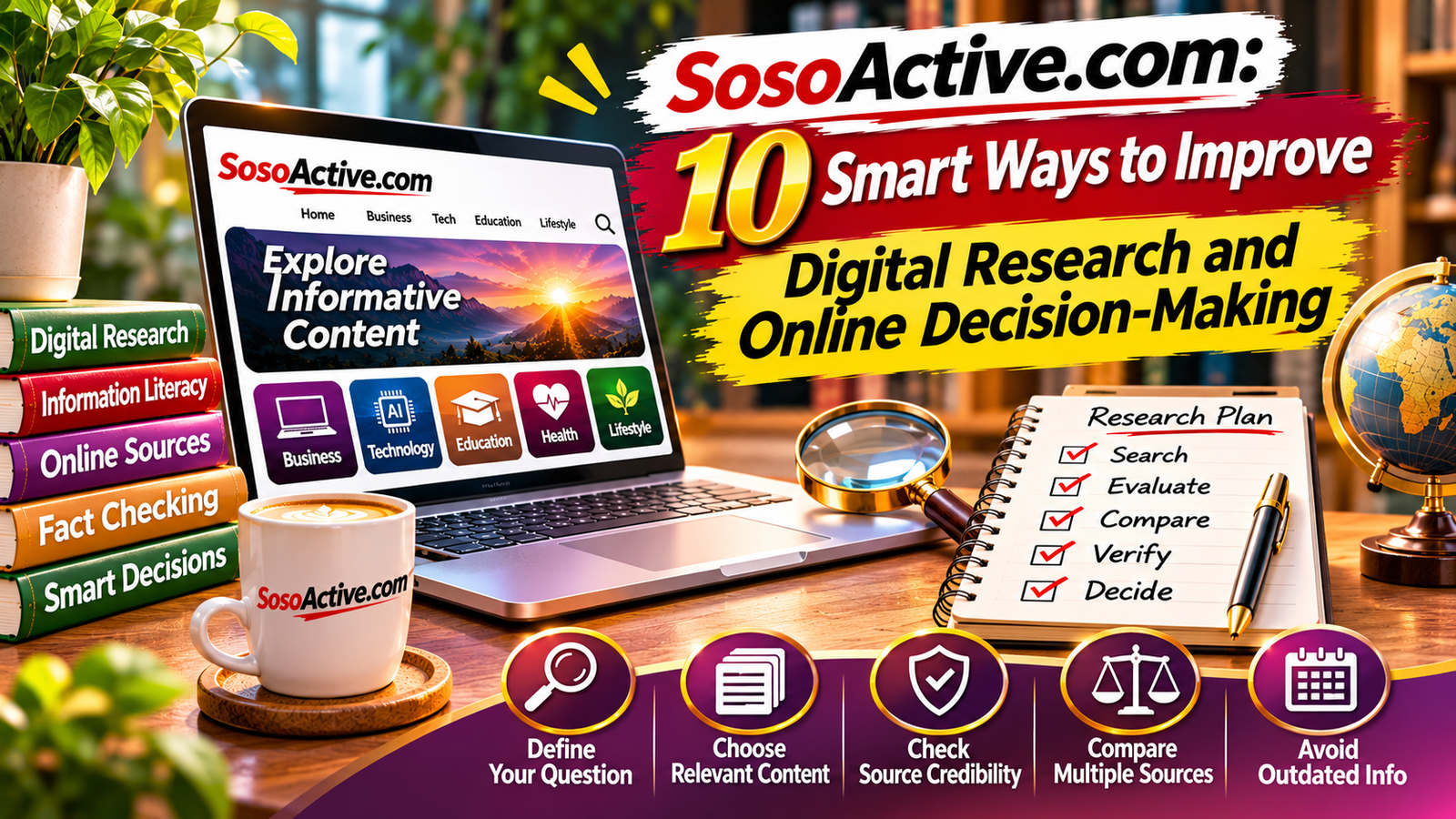
SosoActive.com is the focus of this guide to smarter online research and information discovery. Instead of treating a website as a place to scroll through randomly, readers can approach SosoActive.com with a clear learning objective and a practical method for evaluating what they find.
This article explains ten useful ways to improve digital research, recognize trustworthy information, and turn online reading into better decisions. These strategies can be applied to digital magazines, educational websites, blogs, and other online resources.
1. Define the Problem Before Searching for Answers
Good research begins with a clear understanding of the problem. Without a specific question, it is easy to collect information that looks interesting but does not help with the task.
For example, someone interested in starting an online business might search for general business advice. A more useful question would be: Which costs should a beginner consider before launching an online store?
This smaller question creates a clear direction. It also helps the reader identify which details are relevant.
When exploring SosoActive.com, begin by deciding what you want to understand. A focused question can make your visit more productive and prevent unnecessary browsing.
Try this simple process:
- Write your main question in one sentence.
- Identify the information you need to answer it.
- Choose a relevant subject or article.
- Record any details that require further checking.
A useful research question should be specific but flexible enough to allow new discoveries. Readers using SosoActive.com can follow this method whenever they explore an unfamiliar subject.
2. Understand Search Intent and Choose Relevant Content
Search intent describes the reason behind a person’s online search. Someone searching for a definition wants a different answer from someone comparing products or looking for instructions.
Understanding this difference helps readers choose the right type of content.
There are several common search intentions:
Informational intent: The reader wants to understand a subject or learn a concept.
Navigational intent: The reader wants to reach a particular website or page.
Commercial investigation: The reader is comparing products, services, or possible solutions.
Transactional intent: The reader is ready to complete an action, such as making a purchase or registering for a service.
When browsing SosoActive.com, consider whether an article matches your reason for visiting. A general introduction may be useful for learning, but it may not provide enough detail for a purchasing decision.
This distinction saves time and improves the quality of online research. It also helps readers recognize when they need a tutorial, comparison, expert explanation, or official document instead of another general article.
3. Evaluate the Source Before Trusting the Information
A professional website design does not automatically make every statement accurate. Readers should evaluate the source, author, publication date, and supporting evidence before relying on important information.
When reviewing SosoActive.com, look at the actual content rather than making assumptions based on its appearance. Check whether an article identifies its author and whether important claims are supported by relevant references.
Use these questions as a quick credibility test:
- Who created the information?
- Does the author explain the subject clearly?
- Is the publication date available?
- Are important statements supported by evidence?
- Does the article distinguish facts from opinions?
- Can important details be confirmed elsewhere?
For example, an article discussing a scientific finding should ideally identify the research or institution behind that claim. A product recommendation should explain the reasons for its evaluation.
Readers exploring SosoActive.com should apply these checks consistently. They are useful for identifying reliable material and recognizing when additional research is necessary.
Read more: ArcyArt Directory: 7 Creative Ways to Explore Art and Visual Storytelling
4. Compare Multiple Sources Instead of Relying on One Article
One article rarely provides every detail about a complicated subject. Different writers may focus on different aspects, use different examples, or interpret information from different perspectives.
Comparing sources helps readers identify agreements, differences, and missing context.
Suppose you are researching a new technology tool. One article may explain its features, another may discuss its limitations, and the official website may provide current specifications. Looking at all three can create a more complete understanding.
The same approach works when researching SosoActive.com or any other digital publication. Do not treat one article as the final authority when the subject requires more detailed verification.
A simple comparison table can help:
| Research point | Source A | Source B | What to verify |
|---|---|---|---|
| Main claim | What it says | What it says | Supporting evidence |
| Publication date | Date available | Date available | Which is more current |
| Examples | Examples used | Examples used | Whether they are relevant |
| Limitations | Mentioned or missing | Mentioned or missing | Additional context |
Comparing sources does not mean believing whichever article appears most frequently. It means checking the quality and relevance of the evidence.
5. Learn to Recognize Outdated Information
Online information can lose its value when circumstances change. Technology updates, product prices fluctuate, business rules evolve, and public guidance may be revised.
This makes publication dates important. A page that was accurate several years ago may no longer explain the current situation.
Readers exploring SosoActive.com should pay attention to dates when an article discusses subjects that change frequently. If a page explains software features, confirm them with the provider’s current documentation.
For financial, legal, or government-related subjects, look for current information from the relevant official authority.
A practical freshness checklist includes:
- Find the original publication or update date.
- Identify details that may have changed.
- Open the supporting references.
- Compare important claims with current sources.
- Avoid relying on outdated figures or instructions.
Readers should also remember that a recently published article is not automatically accurate. Freshness and credibility are separate qualities.
Using this approach while exploring SosoActive.com can help prevent outdated information from influencing important decisions.
6. Use Official Sources for Important Decisions
General articles are useful for learning, but certain decisions require stronger evidence. Health, finance, law, taxes, cybersecurity, and safety are examples of subjects where inaccurate information can have serious consequences.
If an article raises a question about one of these areas, readers should look for guidance from the relevant official organization or qualified professional.
For example, the World Health Organization provides public-health information and resources. Readers researching online security can also consult the Cybersecurity and Infrastructure Security Agency for practical cybersecurity guidance.
These resources can help verify general information, although local requirements and individual circumstances may differ.
When using SosoActive.com as part of research, remember that a general article is not necessarily a substitute for official guidance. Check the original source before following instructions that could affect your health, money, legal rights, or personal security.
This habit makes digital research more responsible and helps readers separate introductory information from professional advice.
7. Organize Research Notes to Avoid Information Overload
Collecting too many articles can make research confusing. Readers may save dozens of links but later forget why they were important.
A better method is to create short, organized notes while reading.
When exploring SosoActive.com, record the central idea of an article, one useful detail, and any question that remains unanswered. This gives you a clear reference without requiring you to save every paragraph.
You can organize research into four simple groups:
Main ideas: The most important points from your reading.
Supporting evidence: Statistics, examples, or references worth checking.
Questions: Details that remain unclear.
Next actions: Practical steps or additional research needed.
For example, someone researching digital marketing might save an article about customer behavior and note that they still need to compare different advertising channels.
This method makes information easier to revisit. It also helps readers use SosoActive.com as one part of an organized learning process instead of collecting disconnected pages.
8. Recognize Bias and Promotional Content
Not every online article is written with the same purpose. Some pages aim to educate, while others express opinions, promote products, or encourage readers to take a particular action.
Understanding the purpose of content is an important part of information literacy.
When evaluating SosoActive.com, consider whether an article presents a balanced explanation or focuses mainly on encouraging a particular decision. Look for commercial disclosures where relevant and check whether product claims have independent support.
Common warning signs include:
- Guaranteed results without convincing evidence.
- Extremely dramatic headlines.
- Missing information about costs or limitations.
- Product recommendations without clear reasoning.
- Statistics without identifiable sources.
- Pressure to act immediately.
Promotional content is not automatically misleading. However, readers should understand when a commercial interest may influence the presentation.
Comparing recommendations with independent information can provide a more balanced view. This is especially useful before making purchases or choosing a service.
9. Turn Reading Into Practical Knowledge
Reading becomes more valuable when it changes what you understand or helps you complete a task. Simply finishing an article does not guarantee that the information will be remembered.
An effective learning method involves summarizing, questioning, and applying the main ideas.
After reading SosoActive.com, try explaining the central message in your own words. If you cannot describe it clearly, revisit the sections that were difficult to understand.
You can use this four-step learning technique:
- Read: Understand the main topic and its supporting points.
- Summarize: Explain the article in a few sentences.
- Question: Identify anything that needs further research.
- Apply: Find a practical way to use the information.
For example, after reading about productivity, you might test one suggested planning method for a week and evaluate whether it improves your routine.
This approach turns online reading into active learning. It also encourages readers to explore SosoActive.com with a purpose rather than treating every article as something to consume and forget.
10. Develop a Consistent Digital Research Routine
Research becomes easier when readers follow a repeatable process. A simple routine can prevent unnecessary browsing and make it easier to recognize useful information.
You do not need to spend hours reading every day. A short, focused session can be enough to understand a basic subject or identify questions for deeper investigation.
Here is a practical routine:
Step 1: Choose a topic. Select a subject connected to a real question or task.
Step 2: Find relevant content. Choose articles that match your research goal.
Step 3: Review the source. Check the author, date, and supporting references.
Step 4: Compare important details. Use additional sources when accuracy matters.
Step 5: Record the takeaway. Save a short summary and any unanswered questions.
Step 6: Decide what comes next. Apply the information or continue researching.
Readers can use this process while exploring SosoActive.com and other online resources. Over time, a consistent routine can improve research efficiency, information evaluation, and confidence when learning unfamiliar subjects.
Read more: Understanding Market Indicators: Which Ones Abbado Recommends
Frequently Asked Questions
What is SosoActive.com?
SosoActive.com is the website discussed in this article in the context of digital research and online information discovery. Readers should visit the website directly to confirm its current content, features, and publishing details.
How can I find useful information online?
Start with a specific question, select relevant articles, check the sources, and compare important claims. Avoid relying on headlines alone.
Why should I compare different online sources?
Different sources may provide additional context, examples, or evidence. Comparing them helps readers identify missing details and recognize conflicting claims.
How can I recognize outdated online content?
Check publication dates, review supporting links, and confirm time-sensitive information with current official sources. This is particularly important for technology, financial, and legal topics.
Can online articles replace professional advice?
No. General articles can provide background information, but decisions involving health, law, finance, or safety may require qualified professional guidance.
Conclusion: Become a More Confident Online Researcher
Digital information is valuable when readers know how to find it, understand it, and evaluate its reliability. A clear research question, careful source selection, and organized notes can make online learning more productive.
SosoActive.com provides the subject for exploring these important digital research habits. Readers should approach online publications with curiosity while checking the relevance, freshness, and credibility of individual articles.
The most useful research process does not end when a page is closed. It continues when readers compare information, ask better questions, and apply what they have learned responsibly.
Whether you are exploring business, technology, education, or general knowledge, critical thinking remains essential. Use online content as a starting point, verify important claims, and make decisions based on relevant evidence rather than assumptions.





Leave a comment