




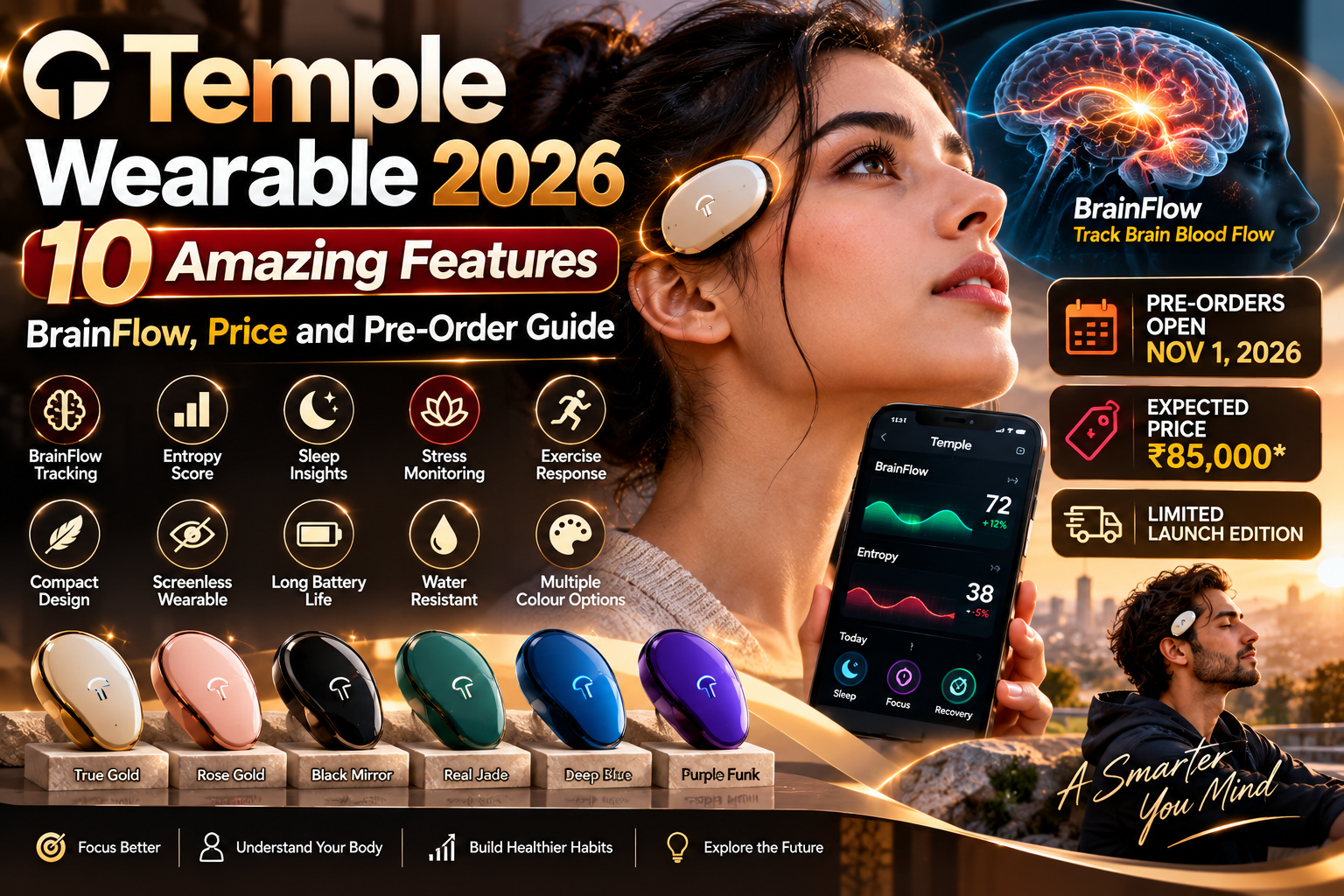
Most consumer wearables are designed for the wrist or finger. They count steps, estimate sleep, record workouts and display familiar health indicators. Temple takes a different approach: it is a compact, screenless device designed to attach near the side of the head and collect optical signals associated with cerebral blood flow.
Interest in Temple Wearable 2026 is growing because the product explores a specialised type of physiological tracking rather than trying to replace every function of a smartwatch. The device is being developed by Temple, the wearable technology venture founded by Deepinder Goyal, known for co-founding Zomato and leading its parent company, Eternal.
The product centres on two company-described metrics: BrainFlow, a proxy intended to reflect changes associated with cerebral blood flow, and Entropy, a score described as an indicator of physiological strain. These are emerging measurements, not established medical diagnoses. This guide examines the design, technology, reported launch details, research questions, possible uses and buying considerations, while separating reported facts from claims that still need independent validation.
Temple Wearable 2026 remains experimental. Temple Wearable 2026 needs independent validation.
1. What Is Temple and Why Is It Different?
Temple is a small wearable that sits against the skin near the temple instead of wrapping around the wrist. It uses optical sensing to collect signals from that location and estimate changes associated with blood flow in the brain. That unusual placement is the main reason the product has attracted attention.
Temple Wearable 2026 is not simply a conventional smartwatch with a different shape. Its purpose is to explore whether a wearable sensor near the head can provide useful information about physiological changes during everyday activities. Deepinder Goyal has connected the project to a broader idea he calls the Gravity Ageing Hypothesis, which explores whether gravity-related changes in circulation could be relevant to ageing. This remains a hypothesis under investigation, not an established explanation of ageing or cognitive decline.
For background, read Business Standard’s Temple explainer.
Temple Wearable 2026 focuses on BrainFlow. Temple Wearable 2026 is not diagnostic.
2. BrainFlow: The Core Measurement
BrainFlow is the name Temple uses for its proprietary measure intended to track changes associated with cerebral blood flow. The device uses photoplethysmography, commonly called PPG. This optical technique shines light into tissue and measures changes in reflected light that can be associated with variations in blood volume.
The sensor location is important. Many existing consumer wearables collect optical signals from the wrist, while Temple is designed to sit near the temple. The company’s premise is that this placement may offer a useful way to observe signals related to circulation near the head.
Temple Wearable 2026 should not be described as directly measuring every aspect of brain function. BrainFlow is a company-defined proxy, and the meaning of its readings depends on the quality of the validation work. A sensor reading, a research metric and a clinically validated diagnostic result are not interchangeable. Users should treat the output as wellness-oriented information unless appropriate evidence and regulatory status support stronger claims.
The distinction matters because cerebral blood flow is complex. Readings can be affected by sensor placement, movement, individual physiology and measurement conditions. Independent research is needed to establish how consistently the device performs across different people and real-world situations.
Temple Wearable 2026 introduces Entropy. Temple Wearable 2026 needs clear metric explanations.
3. Entropy: A Second View of Physiological Strain
Temple also presents a metric called Entropy. The company describes it as a way to represent the body’s changing physiological strain, with a score reported on a scale from 1 to 250. According to descriptions shared by Goyal and reported by technology publications, the score may respond to factors such as sleep, stress, exercise, caffeine and meditation.
A user might compare readings after a demanding workout with readings during a quiet recovery period. Over time, the companion app may help users explore patterns in their own data. That could make the metric interesting for people who enjoy tracking routines and experimenting with lifestyle changes.
However, Temple Wearable 2026 uses a proprietary metric. Users should not assume that Entropy is equivalent to a clinically accepted stress test or a universal measure of health. The company will need to explain its methodology clearly and provide evidence that the score is repeatable, interpretable and meaningful. A changing score can be an observation; it does not, by itself, explain why the body changed.
Read more: about zarovviraf153: 10 Smart Ways to Research an Unknown Online Phrase
4. Compact, Screenless Design and How It Is Worn
One of the product’s most distinctive features is its form factor. Temple has been described as a small, pebble-shaped or pill-like device that attaches to the side of the head. It does not rely on a conventional watch display and is designed to sync information with a companion smartphone application.
The company has said that the latest version became substantially smaller than earlier prototypes. Its low-profile design is intended to fit alongside everyday items such as glasses, although comfort and fit can vary between people.
Temple Wearable 2026 uses adhesive attachments called Grips to hold the sensor against the skin. The company has described these as medical-grade adhesives and has recommended replacing them regularly. Reports indicate a replacement interval of around two to three days, although actual use conditions may differ.
Before ordering, buyers should check instructions for skin compatibility, cleaning, Grip replacement and wearing duration. People with sensitive skin or adhesive allergies should be cautious and seek advice if irritation develops.
Temple Wearable 2026 uses adhesive Grips. Temple Wearable 2026 requires skin-contact comfort.
5. Everyday Use: Sleep, Exercise, Posture and Recovery
The product’s wider ambition is to observe physiological signals while people go about normal routines. The company has discussed aerobic exercise, meditation, sleep, prolonged sitting and changes in posture as situations that may affect its measurements.
Potential areas of exploration include comparing readings during rest and after exercise, reviewing trends across sleep and waking hours, and examining whether posture or movement is associated with changes in recorded signals. This is a different proposition from simply counting steps or estimating calories.
Temple Wearable 2026 may appeal to people who enjoy experimenting with personal health data. Still, users should avoid interpreting a single score as proof that a particular activity is improving or harming their brain. A wearable trend can prompt questions, but it cannot independently establish cause and effect. Medical concerns should be discussed with a qualified healthcare professional rather than managed through a consumer device.
Temple Wearable 2026 explores daily patterns. Temple Wearable 2026 cannot prove causation.
6. Smartphone App and the Data Experience
Because the device is screenless, its companion application is central to the experience. The app is expected to present measurements, help users review trends and provide context for the numbers generated by the sensor. A useful health application should do more than display charts: it should explain what each metric represents, how it is calculated, what can affect it and what it cannot tell the user.
Temple Wearable 2026 will be easier to evaluate once customers and independent reviewers can examine the actual software. Important questions include whether the app provides historical comparisons, exports, understandable summaries, alerts, data controls and transparent explanations of measurement limitations.
Privacy also deserves attention. Before connecting a health-related wearable to a personal account, users should read the privacy policy and understand what information is collected, stored, shared and retained. Buyers should look for clear account controls and a straightforward way to understand or manage their data.
Temple Wearable 2026 depends on its app. Temple Wearable 2026 needs transparent data controls.
7. Battery, Water Use and Adhesive Maintenance
Comfort and maintenance can determine whether a wearable becomes part of a daily routine. Business Standard has reported a battery life of around seven days and described the device as designed for activities such as showering and swimming. Buyers should confirm final specifications and usage restrictions with the company before relying on those reports.
The Grips are an important part of ownership. Since the device attaches to the skin, users need to understand how often adhesives must be changed, whether replacement supplies are included and what happens if a Grip loses adhesion. The company has discussed a supply of Grips as part of the ownership proposition, but buyers should check exactly what their order includes.
Temple Wearable 2026 should be assessed not only by its sensor concept but also by practical details: charging time, durability, skin comfort, water resistance, cleaning, replacement supplies and after-sales support. These factors affect the real cost and convenience of ownership.
Temple Wearable 2026 needs practical testing. Temple Wearable 2026 ownership includes maintenance questions.
8. Price, Pre-Orders, Colours and Delivery
As of October 30, 2026, public pre-orders are reported to be scheduled to open on November 1, 2026. Moneycontrol reported on October 29 that early-access users had begun receiving pre-order information, with wider bookings expected to follow. The company is using a phased, made-to-order approach rather than immediately producing large volumes.
The price requires careful wording. Digit and NDTV Profit reported that early-access invitations listed approximately ₹85,000, with lifetime access to the software platform included. However, reports also note that the final official price and terms should be confirmed through the company’s own ordering process. Do not treat a reported invitation price as a universally confirmed retail price.
Temple Wearable 2026 has been reported in six finishes: True Gold, Rose Gold, Black Mirror, Real Jade, Deep Blue and Purple Funk. Some colours have been described as limited editions, and availability may depend on the launch batch. Recent coverage has described a delivery window of up to three months after purchase, while earlier launch reporting discussed shipments before the end of 2026. Buyers should rely on the delivery estimate displayed at checkout.
For launch updates, see Moneycontrol’s pre-order report, Digit’s price and design guide, and NDTV Profit’s early-access pricing report.
Temple Wearable 2026 has reported launch details. Temple Wearable 2026 pricing needs official confirmation.
9. What Does the Research Say?
A central question is whether the optical readings reliably reflect changes in blood flow inside the brain rather than signals from the scalp or surrounding tissue. This is a difficult measurement problem, which is why validation matters.
Business Standard’s October 2026 explainer describes two early validation efforts discussed by the company. One compared BrainFlow readings with transcranial Doppler measurements in 23 healthy adults. Another reported a comparison with time-domain near-infrared spectroscopy in 44 healthy young men across 60 sessions.
These reports provide useful context, but they should be interpreted carefully. Early studies, small participant groups and company-shared findings do not establish that a consumer wearable can diagnose disease or predict an individual’s long-term neurological health. Independent replication, peer review, broader participant groups and clearly published methods are important next steps.
Temple Wearable 2026 is best approached as an emerging wellness and research product. It should not replace medical assessment, prescribed monitoring or advice from a qualified healthcare professional.
Temple Wearable 2026 has early research. Temple Wearable 2026 needs broader independent studies.
10. Temple Compared with a Smartwatch or Fitness Band
A smartwatch is generally designed for broad everyday functions: notifications, activity tracking, workout modes, heart-rate estimates and sometimes sleep or oxygen-related features. Temple has a narrower and more experimental focus.
| Comparison | Temple | Typical smartwatch |
|---|---|---|
| Wearing position | Side of the head | Wrist |
| Main focus | BrainFlow and Entropy metrics | General fitness and daily activity |
| Display | Screenless device | Usually has a screen |
| Attachment | Adhesive Grips | Strap or band |
| Data access | Companion app | App and on-device display |
| Evidence needs | New metrics need further validation | Depends on each feature |
Temple Wearable 2026 is not a direct replacement for a smartwatch. Someone who wants notifications, step counts and familiar workout tools may find a conventional watch more practical. Someone curious about emerging head-worn sensing may find Temple more distinctive. The right choice depends on the buyer’s needs rather than novelty alone.
Temple Wearable 2026 differs from watches. Temple Wearable 2026 serves a specialised purpose.
Read more: Historical Examples of Truth-Tellers
11. Who Might Consider Buying It?
The product may interest technology enthusiasts, early adopters, people who enjoy tracking personal data and researchers following wearable sensing. It may also attract consumers who want to explore measurements beyond conventional wrist-based fitness tracking.
However, the reported premium price makes it important to think carefully before ordering. Buyers should ask what information they will actually receive, whether the app makes that information understandable, how much evidence supports the metrics and what support is available if the device does not fit comfortably.
Temple Wearable 2026 may be worth watching, but waiting for independent reviews could be sensible for people who prefer established products and proven measurements. Anyone seeking a medical diagnosis or treatment decision should consult a healthcare professional rather than rely on a consumer wearable.
Temple Wearable 2026 may interest early adopters. Temple Wearable 2026 is not for every buyer.
12. Questions to Ask Before Pre-Ordering
Before committing to a first-generation wearable, review the purchase terms and technical details. Ask whether the displayed price includes taxes and delivery; whether lifetime software access is clearly defined; how replacement Grips can be obtained; what battery life is promised; which water-resistance conditions are supported; and what return, replacement and warranty policies apply.
Also examine the estimated delivery window for the specific batch, how the company protects personal health data and what independent research supports the measurements. Finally, distinguish wellness features from medical capabilities. These questions are especially relevant to Temple Wearable 2026 because it is a new product category with unfamiliar metrics and a premium reported price.
A first-generation product can be exciting, but early buyers also take on uncertainty. Waiting for hands-on reviews may reveal how comfortable the device is during sleep, exercise and ordinary daily movement.
Temple Wearable 2026 deserves careful evaluation. Temple Wearable 2026 buyers should check terms.
Conclusion: Is Temple Worth Watching in 2026?
Temple is an unusual entry into the wearable market. Its head-worn design, optical sensing approach, BrainFlow metric and Entropy score make it different from conventional smartwatches and fitness bands. The idea of observing physiological changes associated with cerebral blood flow during everyday life is interesting, but its value will depend on transparent methods, independent validation and a useful software experience.
For early adopters, Temple Wearable 2026 is a launch worth following as pre-orders approach. For cautious buyers, the best decision may be to wait for independent testing, confirmed specifications and real-world feedback. The reported price, adhesive maintenance, battery performance, comfort and privacy terms all deserve attention before purchase.
The most important point is to keep expectations realistic. Temple may offer a new way to explore personal physiological data, but it is not a proven medical diagnostic device. Its long-term success will depend on whether the measurements are reliable, understandable and genuinely useful to the people wearing it.
Temple Wearable 2026 is worth monitoring. Temple Wearable 2026 success depends on evidence.





Leave a comment