Introduction
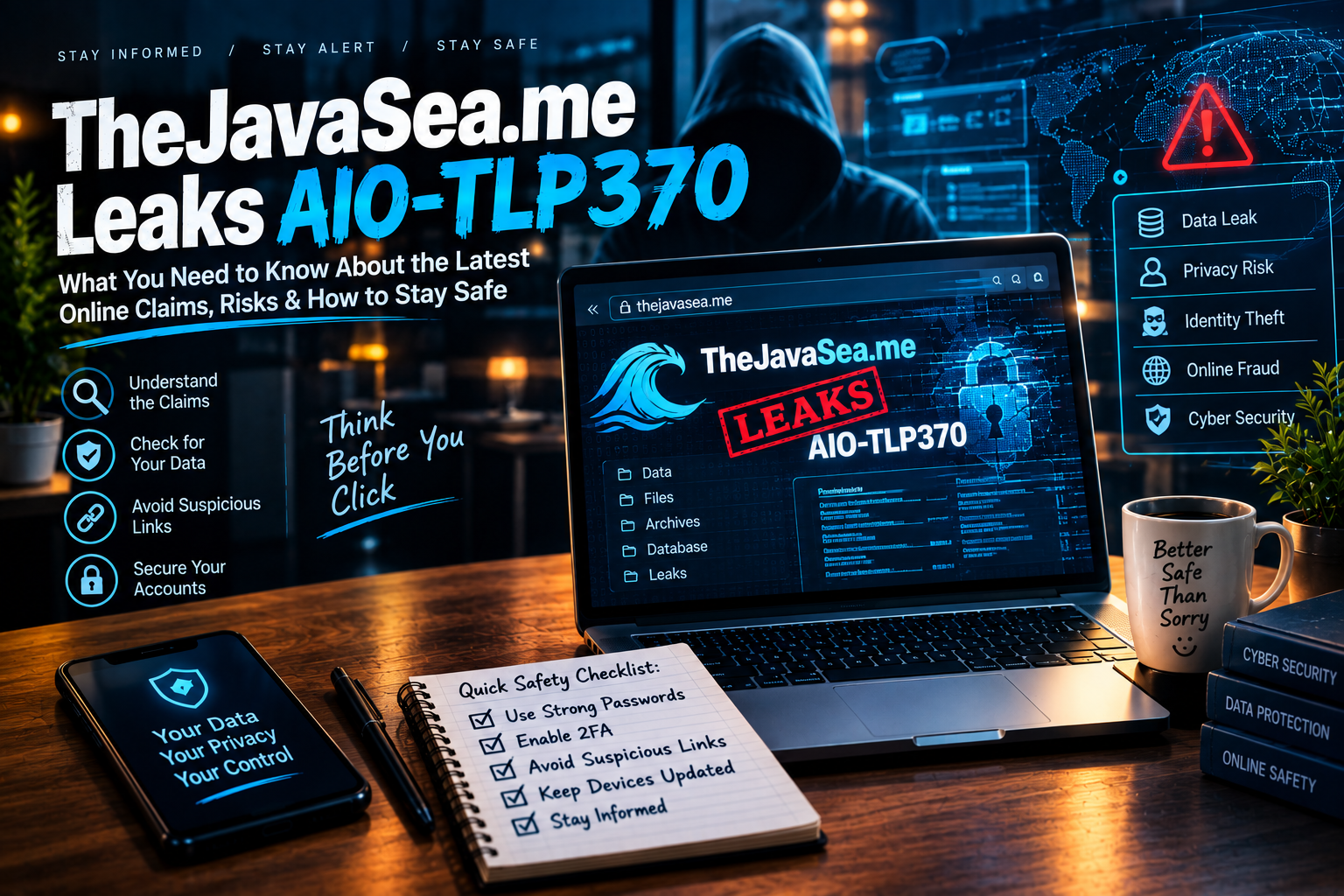
The phrase thejavasea.me leaks aio-tlp370 has attracted attention because it looks like the name of a specific cybersecurity incident or digital release. However, current public reporting does not provide enough authoritative evidence to establish the exact contents, origin, size, affected organizations, or status of the material associated with the label. Several secondary pages describe it as a leak-related archive, package, or identifier, but their descriptions are not fully consistent.
For readers searching thejavasea.me leaks aio-tlp370, the safest approach is to separate documented information from assumptions repeated across the internet. You do not need to visit suspicious pages, open unknown archives, or download questionable files to protect yourself. Instead, focus on account security, exposure checking through reputable services, and basic device protection.
1. Why the Keyword Is Creating Confusion
The term thejavasea.me leaks aio-tlp370 looks technical because it combines a domain name, the abbreviation AIO, and a number. Some online coverage interprets AIO as “All-In-One,” suggesting a bundle rather than a single record. That interpretation is plausible, but it should not be treated as an official definition without reliable evidence from the original source.
The number 370 should also not automatically be treated as a record count, victim count, file count, or confirmed version. A label can be a thread name, archive reference, package identifier, or internal naming convention. For anyone researching thejavasea.me leaks aio-tlp370, avoiding unsupported assumptions is the first step toward a more accurate understanding.
2. What Can Actually Be Verified?
Current discussion of thejavasea.me leaks aio-tlp370 is largely based on secondary websites and repeated online descriptions. Those pages can show what people are searching for, but repetition does not independently prove every claim. Recent coverage itself notes that the exact contents and origin remain difficult to verify.
A stronger incident report would normally identify an affected organization, explain when the incident occurred, describe what information was exposed, or provide technical evidence. When thejavasea.me leaks aio-tlp370 is discussed without that kind of evidence, readers should treat precise claims about victims, records, or file sizes as unverified rather than established facts.
3. Do Not Confuse TLP370 With Official TLP
One important point about thejavasea.me leaks aio-tlp370 is that the letters “TLP” should not automatically be interpreted as an official cybersecurity classification. FIRST maintains the Traffic Light Protocol, a legitimate framework for controlling the sharing of sensitive information.
FIRST’s TLP 2.0 documentation recognizes TLP:RED, TLP:AMBER, TLP:GREEN, and TLP:CLEAR. “TLP370” is not one of those official labels. Therefore, anyone reading about thejavasea.me leaks aio-tlp370 should not assume that the name itself provides an authenticity or security certification.
Read more: Cruzdid com: 9 Powerful Insights Into a Growing Digital Content Website
4. Why Unknown Downloads Are Risky
People searching thejavasea.me leaks aio-tlp370 may encounter pages that promise archives, screenshots, databases, or other material. Opening or downloading unknown files can create risks regardless of whether the original leak claim is genuine.
A suspicious archive can contain malware, credential-stealing code, malicious scripts, or a fake document designed to collect information. A download can also lead to phishing pages or unwanted software. The safest response to thejavasea.me leaks aio-tlp370 is therefore to avoid questionable files and investigate personal exposure through trusted channels instead.
5. Privacy Risks Can Outlast the Original Post
The topic of thejavasea.me leaks aio-tlp370 is not only about a possible package or online post. If personal information has genuinely been exposed somewhere, copies can continue circulating through reposts, screenshots, archived pages, and unrelated collections.
Email addresses, usernames, passwords, phone numbers, or other identifiers can sometimes be combined with information from older incidents. That can make later phishing attempts more convincing. For people concerned about thejavasea.me leaks aio-tlp370, the practical lesson is to strengthen accounts rather than trying to locate questionable material.
6. Password Reuse Makes Exposure More Serious
When people investigate thejavasea.me leaks aio-tlp370, one of the most useful security checks is reviewing password reuse. A password shared across email, social media, shopping, cloud storage, or other services can create a chain reaction if it becomes known.
Use a different strong password for every important account, preferably with a reputable password manager. Give special attention to your main email account because it may be used to reset other passwords. If thejavasea.me leaks aio-tlp370 has made you reconsider old credentials, changing reused passwords is a sensible preventive step even without proof that your account appeared in a specific package.
7. Multi-Factor Authentication Adds Protection
Another useful response to concerns about thejavasea.me leaks aio-tlp370 is enabling multi-factor authentication. Depending on the service, MFA may use an authenticator app, security key, passkey, or another approved verification method.
MFA cannot eliminate every type of account attack, but it can reduce the impact of a stolen password. When reviewing accounts because of thejavasea.me leaks aio-tlp370, prioritize email, cloud storage, work accounts, social platforms, and services containing sensitive personal information. Also review recovery methods so an attacker cannot easily replace your recovery address or phone number.
8. Watch for Follow-Up Phishing
Search interest around thejavasea.me leaks aio-tlp370 can create another problem: scammers may use the topic itself to build convincing phishing messages. A message might claim that your information was exposed and ask you to verify a password, download a security tool, or open an urgent link.
Do not trust a message simply because it contains your name or other accurate details. If thejavasea.me leaks aio-tlp370 is mentioned in a warning, open the relevant service through its official app or manually entered website address. Avoid unexpected links, countdowns, threats, and requests for credentials.
9. Check Your Exposure Without Accessing Leaked Files
If you are worried about thejavasea.me leaks aio-tlp370, begin with your own accounts rather than searching for the alleged files. Review recent logins, password changes, security notifications, connected devices, and recovery settings.
For email exposure checks related to thejavasea.me leaks aio-tlp370, use reputable breach-notification or identity-protection services instead of unknown sites offering searchable leaked databases. A historical breach result does not automatically prove that your information is included in this particular package. If suspicious activity appears, change the affected password, enable MFA, revoke unfamiliar sessions, and contact the service through its official support channel.
10. Businesses Should Treat Claims as Triage Signals
For organizations, thejavasea.me leaks aio-tlp370 should be treated as a possible security-triage question rather than immediate proof of compromise. Security teams can review authentication logs, endpoint alerts, unusual access patterns, exposed credentials, and changes to privileged accounts.
If a credible indicator connected to thejavasea.me leaks aio-tlp370 appears, the organization should preserve relevant evidence and follow its incident-response process. Depending on the situation, that may include password resets, session revocation, API-key rotation, access reviews, and employee warnings about follow-up phishing campaigns.
11. How to Evaluate a Leak Claim
A useful way to examine thejavasea.me leaks aio-tlp370 is to ask who originally made the claim, whether an affected organization is identified, whether an official disclosure exists, and whether independent reputable sources confirm the same facts. Technical indicators and consistent dates can also improve confidence.
If several articles simply repeat one another, that is not independent verification. In coverage of thejavasea.me leaks aio-tlp370, multiple pages use similar descriptions while acknowledging that exact details remain difficult to establish. Readers should therefore distinguish between an online claim and a confirmed security incident.
12. Newly Posted Does Not Mean Newly Breached
Another issue with thejavasea.me leaks aio-tlp370 is the possibility of old or mixed information appearing in a newer post. Leak-related collections can contain duplicated records, previously exposed credentials, public information, incomplete material, fabricated entries, or data from multiple unrelated sources.
This means the publication date of a page does not necessarily identify the date when information was originally obtained. Anyone researching thejavasea.me leaks aio-tlp370 should look for the underlying evidence and timeline rather than assuming that a newly published article represents a newly discovered breach.
13. What to Do After Opening a Suspicious File
If you already opened a file while researching thejavasea.me leaks aio-tlp370, do not continue opening additional files simply to inspect them. If you suspect malicious activity, disconnect the affected device from unnecessary networks and use trusted security software to assess it.
From a separate trusted device, consider changing important passwords if credentials may have been exposed. When thejavasea.me leaks aio-tlp370 is involved with a business device or highly sensitive information, contact the organization’s IT or security team. Avoid experimenting with unknown scripts or attempting to analyze suspicious executables on your everyday computer.
14. Legal and Ethical Issues Matter
The discussion around thejavasea.me leaks aio-tlp370 can involve information that may be private, confidential, copyrighted, or otherwise restricted. Downloading, redistributing, or publishing leaked material can create legal and ethical problems depending on the jurisdiction and the type of data.
There is also a human cost. If thejavasea.me leaks aio-tlp370 contains real personal information, the people represented in that information may never have agreed to its circulation. Responsible cybersecurity discussion should focus on protecting people, validating claims, and reducing further exposure rather than spreading private material.
15. The Most Important Takeaways
The central lesson from thejavasea.me leaks aio-tlp370 is that an online label is not the same as verified evidence. Current secondary reporting describes the phrase as leak-related, but authoritative public documentation does not establish its exact contents, source, scale, or status as a newly confirmed breach.
Readers can still take useful action. If thejavasea.me leaks aio-tlp370 has prompted concern about your security, use unique passwords, enable MFA, review account sessions, update devices, and be cautious with unexpected messages. These habits remain valuable whether a particular claim turns out to be accurate, exaggerated, recycled, or false.
Read more: As Seen on the Streets – New York in Autumn Season
Frequently Asked Questions
Is AIO-TLP370 a confirmed data breach?
There is not enough authoritative public evidence to establish it as a confirmed standalone breach. Claims about victims, contents, and record counts should be treated cautiously unless supported by credible evidence.
Does TLP370 belong to the official Traffic Light Protocol?
No. FIRST’s TLP 2.0 uses TLP:RED, TLP:AMBER, TLP:GREEN, and TLP:CLEAR. TLP370 is not an official FIRST label.
Should I download an alleged AIO-TLP370 archive?
No. Unknown leak archives can expose you to malware, phishing, malicious scripts, or additional privacy risks. Use safer account and exposure-checking methods instead.
What should I do if my password may be exposed?
Change it on the affected service, make it unique, enable MFA, review active sessions, and change the same password anywhere else it was reused.
Can a leak claim be recycled?
Yes. A newly published page can refer to old, duplicated, incomplete, mixed-source, or fabricated information. Publication date alone does not prove that the underlying data is new.
Conclusion
The safest way to understand the topic is to focus on evidence instead of online hype. The phrase is associated with leak-related discussion, but its exact contents and provenance remain difficult to verify from authoritative public information. The practical risks are easier to address: avoid unknown downloads, protect accounts, verify suspicious messages, and use reputable services when checking possible exposure.
Good cybersecurity does not require accessing questionable files, and anyone searching thejavasea.me leaks aio-tlp370 can stay safe without opening alleged leak material. Strong unique passwords, multi-factor authentication, updated devices, careful phishing awareness, and sensible incident response can reduce risk even when an online claim remains uncertain.
