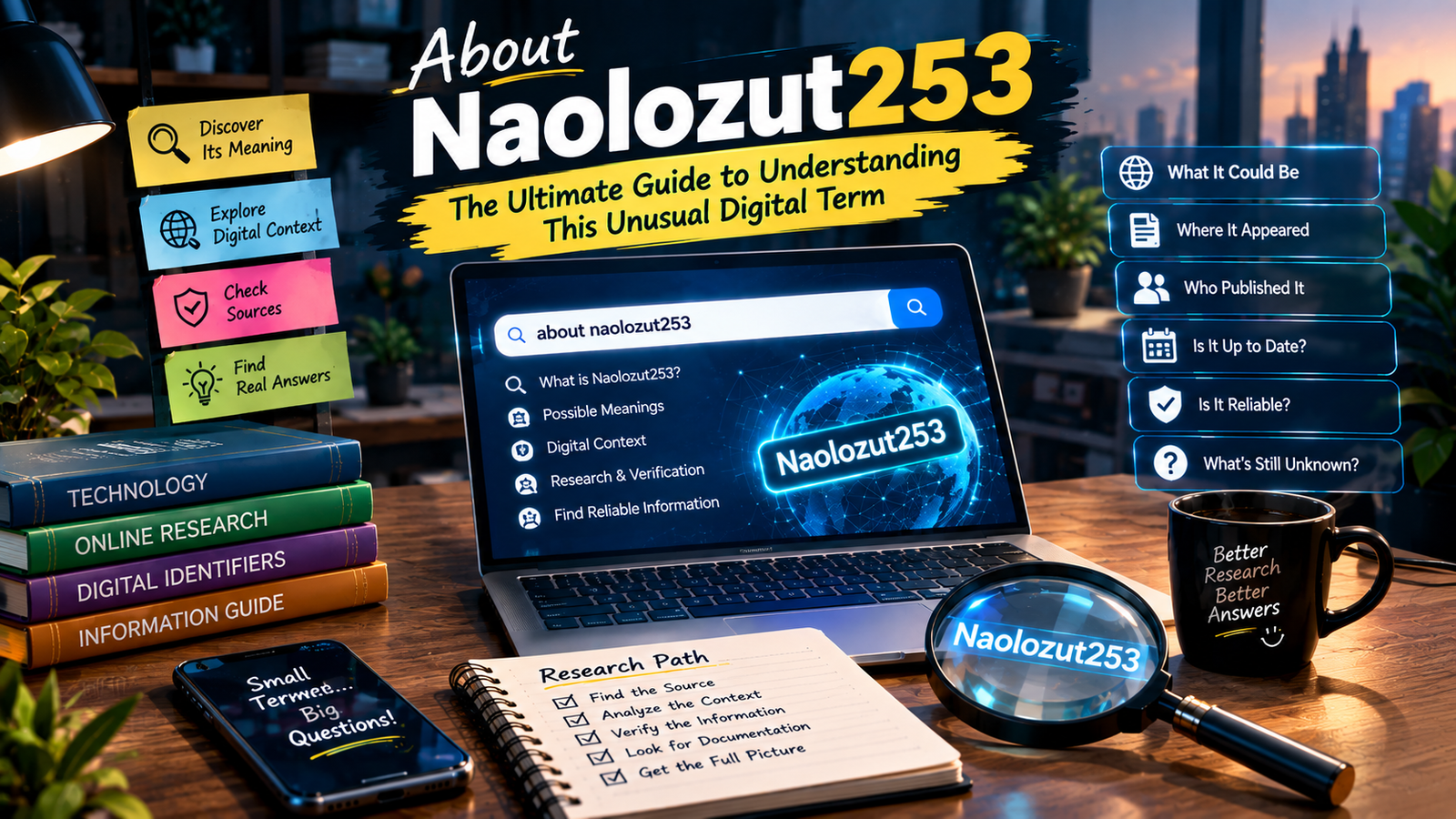
When an unusual word appears online, the first reaction is often simple: search for a definition and accept the first explanation that looks convincing. That method can fail when a term has no established dictionary meaning, appears only in a limited context, or combines letters and numbers in a way that resembles a username, reference code, or generated identifier. About Naolozut253 is useful as a case study for learning a better way to investigate unfamiliar digital terms.
Instead of treating an unfamiliar string as a mystery that must have one hidden answer, it is more productive to examine where it appears, how it is formatted, what surrounds it, and what role it seems to play. This approach avoids unsupported assumptions and turns a confusing term into a structured research problem.
Start With the Shape, Not the Definition
About Naolozut253 immediately looks different from an ordinary English word. It contains a distinctive letter sequence followed by three digits. That visual structure is important because digital systems frequently create names that do not follow normal language patterns.
The letters may be a coined expression, a shortened label, a randomly generated sequence, or a username-style construction. The number may be meaningful, sequential, random, or simply part of the original identifier. Without context, none of these possibilities should automatically be treated as fact.
About Naolozut253 therefore deserves a pattern-first approach. Before asking what it means, ask what it looks like and what kinds of digital objects commonly use similar structures.
Why structure matters
A term’s construction can provide clues without providing a final answer. For example, a mixture of letters and numbers is common in account names, product references, database records, file labels, tracking references, temporary IDs, and automated strings.
This does not prove that a particular term belongs to one of these categories. It simply creates a reasonable list of possibilities that can be tested against evidence.
The Context Test
The strongest clue is often not About Naolozut253 itself but the environment in which it appears. About Naolozut253 could mean something different depending on whether it is found on a profile page, inside software, in a document, within a URL, in a product listing, or in a database-related interface.
Imagine seeing About Naolozut253 next to a profile image and account activity. It may function like a username. If it appears beside a technical field such as “ID” or “reference,” it may be an identifier. If it occurs in a filename, it could simply be a file label.
The surrounding information should therefore be recorded before a conclusion is made.
Build a context snapshot
A useful context snapshot can include:
- The exact spelling and capitalization
- The website, application, or document where it appears
- The words immediately before and after it
- Whether it is clickable
- Whether it appears repeatedly
- Whether it is connected to a person, file, product, or system
- Whether nearby numbers or codes follow a similar pattern
This simple checklist can reveal more than repeatedly searching the same phrase.
Separate Evidence From Possibility
One of the biggest mistakes in digital research is presenting a possibility as a confirmed definition. About Naolozut253 may invite speculation because its structure looks unusual, but unusual does not automatically mean secret, dangerous, official, or meaningful.
A disciplined researcher should use three levels of confidence.
Confirmed: There is direct evidence showing what About Naolozut253 represents in a specific source.
Likely: Several clues point toward one interpretation, but complete confirmation is unavailable.
Possible: The interpretation fits the pattern but needs more evidence.
This distinction keeps an article informative without pretending to know something that cannot be established.
A practical evidence table
For About Naolozut253, a researcher could organize observations like this:
| Observation | What it may suggest | Confidence |
|---|---|---|
| Letters plus numbers | Digital identifier or generated string | Possible |
| Repeated appearance in one account | Username or account label | Likely |
| Appears beside an ID field | System identifier | Likely |
| Found in a filename | File naming convention | Possible |
| Official documentation defines it | Specific technical meaning | Confirmed |
The important point is that the final column should reflect evidence, not personal preference.
Decode the Number Carefully
The “253” portion may attract attention because numbers often look as though they must have a hidden meaning. But a number inside an identifier can serve many ordinary purposes.
It might be a sequence number, a random suffix, a version-like fragment, a personal naming choice, or a value generated automatically by a platform. There is no universal rule saying that three digits must represent a date, location, code, or special message.
When examining About Naolozut253, the best strategy is to compare the number with similar strings from the same source. If many identifiers end in different three-digit values, the digits may simply be generated suffixes. If “253” appears in a consistent field with a documented format, it may have a more specific role.
Avoid forced numerical theories
It is easy to find patterns in numbers when searching long enough. That does not make the pattern meaningful. A strong explanation should connect the number to observable context rather than inventing a symbolic interpretation.
Compare Similar Strings
Another useful technique is pattern comparison. Instead of examining About Naolozut253 in isolation, collect a small sample of similar strings from the same environment.
Suppose a website contains names such as:
- Alpha184
- Nova207
- User241
- Naolozut253
The shared letter-number format may suggest a naming convention. On the other hand, if the term is unique while everything else follows a different format, it may be a one-off label.
Comparison turns a vague question into a measurable one.
Read more: Apply Zealpozold Product: 10 Powerful Rules for a Safer and Smarter Routine
Look for repeated formatting
Pay attention to:
- Character count
- Uppercase versus lowercase letters
- Number placement
- Prefixes and suffixes
- Separators such as hyphens or underscores
- Repeated naming patterns
- Whether the strings are human-readable or machine-generated
These clues can help identify the general category without claiming an unsupported exact definition.
A Better Search Strategy
Searching an unfamiliar term once is rarely enough. A layered search process is more reliable.
First, search the exact phrase in quotation marks. This helps determine whether the complete string appears elsewhere.
Second, search About Naolozut253 with the name of the website, application, or platform where it was found.
Third, search distinctive fragments separately if the exact phrase produces little information.
Fourth, inspect pages that provide actual context rather than relying on snippets alone.
Fifth, compare independent sources before treating a description as authoritative.
When researching About Naolozut253, this sequence is more useful than repeatedly changing one or two words in the same search query.
Why source quality matters
A copied webpage can repeat an incorrect interpretation many times. Repetition does not automatically create evidence.
Primary documentation, original platform pages, technical references, and direct examples generally deserve more weight than anonymous posts or pages that provide no source for their claims.
What About Naolozut253 Might Teach Us About Digital Literacy
The value of an unfamiliar term is not limited to discovering its individual meaning. It can also teach a broader lesson about how digital information works.
Modern platforms produce enormous numbers of identifiers. Users encounter session labels, account handles, transaction references, tracking strings, document IDs, software versions, filenames, and generated codes every day. Many of them are not designed to be meaningful to humans.
About Naolozut253 can therefore be viewed as an example of a wider digital-literacy challenge: understanding that a string can be useful to a system even when it has no obvious dictionary definition.
Human-readable versus machine-readable
Human-readable labels are designed primarily for people. Machine-oriented identifiers are often designed for uniqueness, retrieval, sorting, or system processing.
A mixed string can fall anywhere between these categories. Some are deliberately memorable, while others are generated automatically. Recognizing this distinction prevents researchers from expecting every digital label to behave like a normal word.
When an Unfamiliar Term Deserves Extra Attention
Not every strange identifier requires deep investigation. However, additional research is sensible when About Naolozut253 is connected to an important account, payment, security event, software warning, legal document, or other consequential activity.
In those cases, About Naolozut253 should be investigated using the original source and relevant documentation rather than guesswork.
If a suspicious message asks someone to click a link, provide credentials, transfer money, or install software, the unusual identifier itself should not be treated as proof of legitimacy. Security decisions should be based on the complete message, sender, destination, and verified source.
A Simple Six-Step Investigation Method
A repeatable process makes research faster.
Step 1: Preserve the Exact String
Copy About Naolozut253 exactly as displayed. Small differences in capitalization, punctuation, or numbers can lead to different results.
Step 2: Record the Original Location
Write down where About Naolozut253 appeared and what type of page or system contained it.
Step 3: Capture Surrounding Clues
Note nearby labels, buttons, descriptions, dates, and related identifiers.
Step 4: Search Exact and Contextual Variations
Use the exact term first, then combine it with the source or subject area.
Step 5: Compare Patterns
Look at similar identifiers from the same environment to determine whether the format is common.
Step 6: Assign a Confidence Level
Conclude only as strongly as the evidence allows: confirmed, likely, or possible.
This method makes About Naolozut253 easier to analyze without forcing a definition that the available evidence cannot support.
Common Mistakes to Avoid
Several research habits can produce weak conclusions.
Mistake 1: Assuming every unusual term has a secret meaning.
Some strings are simply generated identifiers.
Mistake 2: Treating the number as automatically symbolic.
Digits may exist only to make a name unique.
Mistake 3: Trusting the first search result.
Search ranking does not guarantee accuracy.
Mistake 4: Ignoring the original context.
The same string can play different roles in different systems.
Mistake 5: Repeating an unsupported claim.
A statement does not become verified merely because multiple low-quality pages copy it.
Avoiding these mistakes creates a more reliable research process.
Why Context Creates Meaning
Language normally gives us clues through grammar, familiar vocabulary, and shared definitions. Digital identifiers often work differently. Their meaning may come almost entirely from their relationship to a system.
About Naolozut253 illustrates this principle well. The characters alone may provide only limited information. The platform, field name, surrounding text, and usage pattern can provide the missing layer of meaning.
This is why context should be treated as evidence rather than decoration.
Quick Questions Readers May Ask
Is About Naolozut253 a standard English word?
About Naolozut253 does not look like a familiar everyday English word, so its role should be determined from context rather than assumed from spelling alone.
Could About Naolozut253 be a username?
About Naolozut253 could function as a username if it appears in an account or profile, but the surrounding interface should confirm that interpretation.
Could About Naolozut253 be a generated code?
About Naolozut253 could also be an automatically generated string if similar letter-and-number combinations appear throughout the same system.
What is the safest way to research About Naolozut253?
About Naolozut253 should be researched through exact searches, original sources, surrounding context, and comparisons with similar identifiers.
Read more: 21 Fall Steals You’ll Want to Own (They’re All Under $100!)
Final Perspective
About Naolozut253 is best approached with curiosity and discipline rather than speculation. Its unusual combination of letters and numbers may resemble a username, generated string, reference label, or another type of digital identifier, but the exact role depends on where and how the term is used.
The strongest approach is to preserve the exact spelling, inspect its environment, compare similar strings, search reliable sources, and separate confirmed facts from reasonable possibilities. This process is useful far beyond one unusual term. It is a practical method for navigating the increasingly complex world of digital names, codes, labels, and identifiers.
In the end, About Naolozut253 does not need to be forced into a single explanation before enough evidence exists. Good digital research is not about producing the fastest answer. It is about producing the most defensible answer—and knowing when the available information is still incomplete.
